



Windischeschenbach
It’s a bright June morning as I board my express train in Munich’s Central Station. There are beers for sale in the station, some of which catch my eye, but there will be enough beer later. I stick with water until Regensburg, where we seem to arrive in a flash and where I grab a commercial bottle of zoigl for my next train to Windischeschenbach. What a name. It means something like “the brook (bach) by the ash trees (eschen) near the Slavs (windisch)”. From here, it’s only 25 km to the Czech border.
While nowhere near as well known among beer lovers as Munich or Bamberg, Windischeschenbach, a town of only five thousand, is the center of one of the oldest and most unique brewing traditions in the world: zoigl, unfiltered and unpasteurized lager beer that’s brewed in community brewhouses, then taken home to ferment in the brewer’s own cellar, and finally served straight from the lagering tank to guests in what is effectively the brewer’s home and part-time pub.
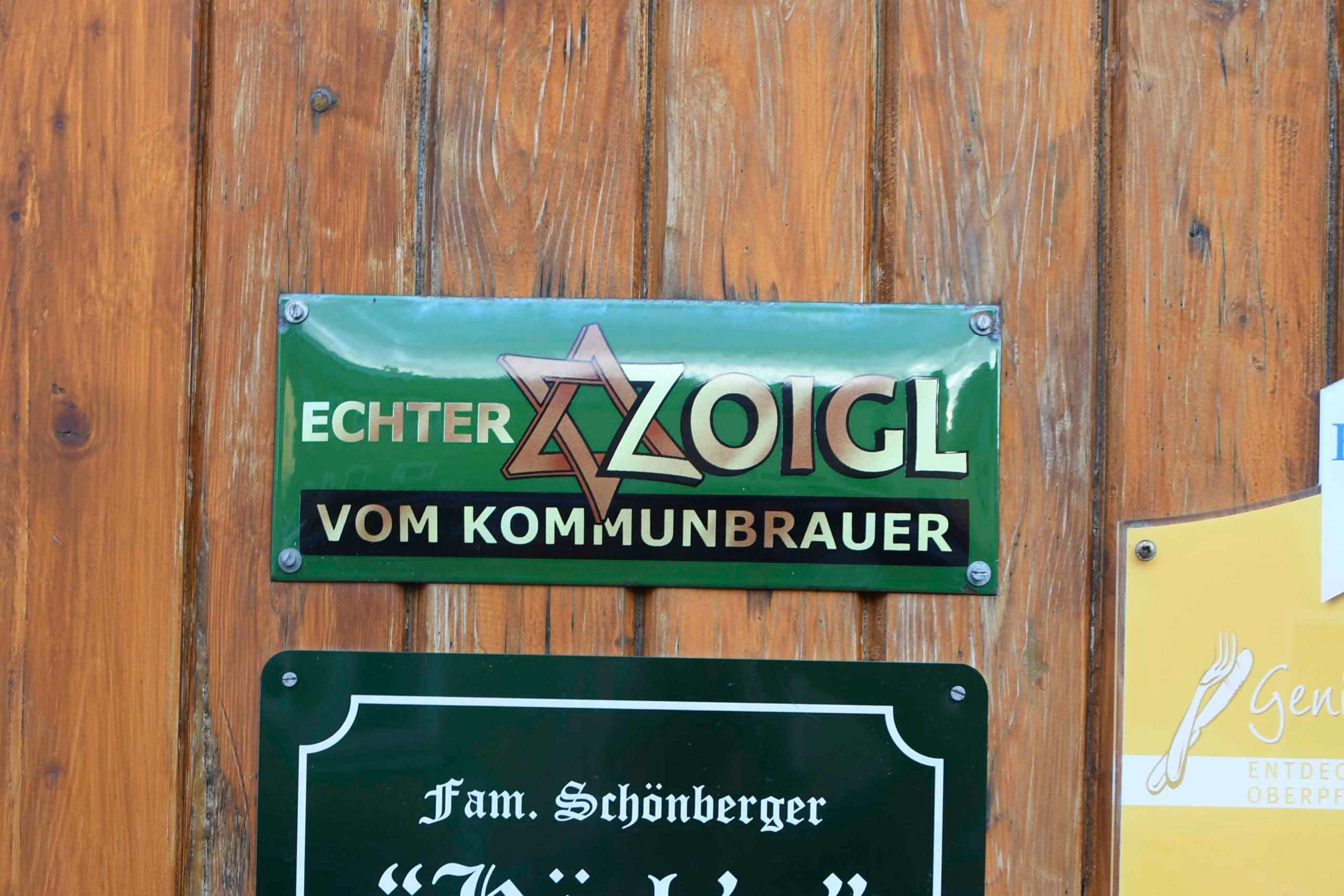
The word ‘zoigl’ is the local dialect word for ‘zeigel’, a sign, as in ‘bierzeigel’, the sign hung outside a pub or restaurant to signify that they have beer for sale. In older times this may have been a branch from a tree or a bush. Today, it’s a six-pointed star, looking much like the Star of David, but historically unrelated. It hangs outside the door of any zoiglstube (zoigl-serving pub/restaurant) that’s open for business. It’s said of the two triangles that make up this star that one signifies the elements fire, earth, and air, and the other the ingredients water, malt, and hops.
There are seven zoiglstube in Windischeschenbach, but this weekend only one, Zum Posterer, will be open. Another six can be found in neighboring Neuhaus, just across the river Waldnaab and up a steep hill. Of these, only Teicher is open. Brewing zoigl in the communal brewery, taking it home to ferment, and serving it in your living room-cum-pub is only a part-time business for these people, so their opening hours rotate from pub to pub. They generally open from Friday until Monday, roughly one weekend per month. The brewers publish a yearly zoigl calendar so the thirsty know where to show up each weekend.
Walking through the town mid-afternoon, I notice several closed zoigl houses. There’s Beim Gloser, which will open next month. Zum Posterer is so unassuming that I walk past it twice before I notice the hanging star. The sign is tiny and the activity is all at the back.
I pass through a central hallway to the small, humble biergarten. It’s really just a small space under a balcony, and it’s a stretch to call it a garden at all. Three 20-something guys, looking like gamers, drink at one table, while six or seven middle-aged men are at another. All eyes lift to me as I make my way to the one small table left in the corner. I soon learn that almost no one comes to these places alone. After a ten-minutes wait, just as I am about to go inside to look for the waitress, she arrives to take my order. I ask for a zoigl–the only beer on the menu (500 ml for €2.10!!!), and take a shot at the bauerngeräuchertes,”farmer’s smoked something or other” (€4.30 for a small), thinking it will probably be pretty good. It turns out to be cured and smoked ham, and it is delicious. It comes with a thick slice of brown bread, butter, and a tiny pickle as its only vegetable accompaniment. The food menu is primarily cold meats, cheese, and bread–hearty farmer’s fare, and no full meals.
Posterer Zoigl is a hazy orange-amber color. The first of my two pints comes with just a bit of lace and is almost still, while the second is softly effervescent and carries a 3 cm-high, airy head. I guess they emptied the first tank. It has a fruity nose with toffee, bread, apple, and light melon notes. The flavor is spicy caramel, apple, bread, cinnamon and pepper. It has a soft, oily body that was almost flat in the first pint but is more prickly in the second. It has a spicy, peppery, bitter finish. This is a very unique, spicy beer with more caramel and toffee than I had expected, and it seems to have endured an extra-long boil.
The main room of the pub is like a large dining room with a small bar in one corner. Upwards of 40 people might fit into it snugly. The old wooden furnishings make for a pretty sight. This afternoon there are mostly older folks inside, sitting in groups, eating and drinking. I am sure it will be more crowded later on.
Across the street from Posterer is the Weisser Schwan (White Swan) Inn, which also houses its own butcher shop. It’s the only pub in Windischeschenbach that serves its zoigl daily. The food here is very meaty and looks quite good, but I sit on the front terrace and stick to beer.
Weisser Schwan Zoigl comes out a brilliant golden color, lightly hazy, and calmly effervescent. It has a 3-cm high foamy head, and is just beautiful to look at. The nose is lemony hops and bready malt. The flavor is sweet and somewhat simple, with peppery, spicy hops, lemon and orange. Carbonation is soft and light. This is a solid beer though not as distinctive as the Posterer. It reminds me of an unfiltered helles from the Munich area: clean, soft, and süffig (drinkable).
Echter Zoigl vom Kommunbrauer: Authentic Zoigl from a Community Brewer
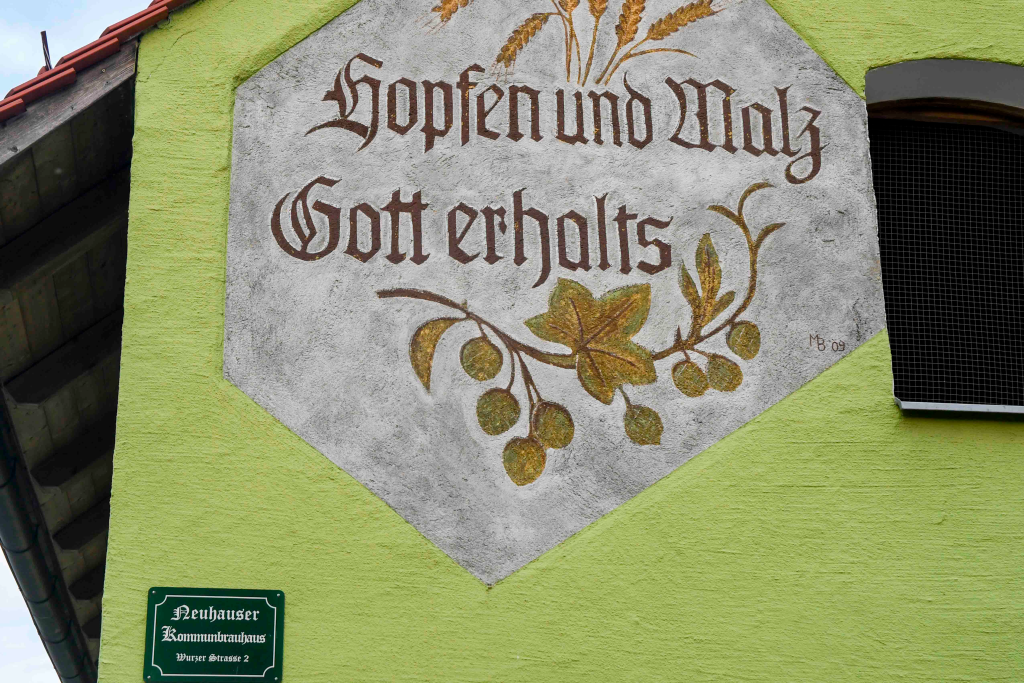
On my walk back down toward the train station, before which I’ll cross the river and climb east towards Neuhaus, I find the kommunbrauhaus (community brewhouse). It’s surprisingly tiny–maybe 30 m2, with a tall brick chimney and a plaque saying that brewing rights have existed here since 1455. There used to be three other community brewhouses in town, it also reads, but they were destroyed in the great fire of 1848. Only this one was rebuilt.
There are five community brewhouses still in operation in the Upper Palatinate region of the state of Bavaria, where authentic “Echter Zoigl” can be brewed by anyone living in the town and possessing brewing rights. Rights are attached to the land, so buying a house means also obtaining brewing rights. Only a small minority of the rights-holding residents brew these days, although in Neuhaus they annually brew batches that residents may share in, taking home just enough for their own consumption.
The community brew houses are as follows, followed by the date the brewing rights were first granted, and the number of commercially available zoigl in town:
| Brew House | Year | Numbner |
| Windischeschenbach | 1455 | 10 |
| Neuhaus | 1415 | 6 |
| Falkenberg | 1467 | 3 |
| Eslarn | 1533 | 1 |
| Mitterteich | 1516 | 3 |
In Neuhaus and Windischeschenbach, the brewers own the brewery. In the other towns, they are owned by the community. Every time beer is brewed, a “kettle fee” is paid to the brewhouse to cover maintenance costs. The only other community brewhouse still functioning in Germany is in the small town of Sesslach, just north of Bamberg, although here, just one beer is made for the whole town. Though not called a zoigl, it is of a similar style and can be sampled in a number of pubs in the town.
Throughout the Upper Palatinate region, there are a couple dozen other pubs that serve zoigl and open for one weekend per month. These either serve an Echter Zoigl made by a brewer in one of the five towns, or else they serve a non-communally-brewed kellerbier that has been branded as a zoigl. While these places are less attractive to zoigl hunters than the actual brewing pubs, they often open on weekends when the brewing pub itself is closed, so they might be the only place to sample a particular beer when you’re here.
Of the five communally-brewing towns, the sister towns of Windischeschenbach and Neuhaus not only have the most brewers, but they are also the easiest to access by train, and thus make a natural base for zoigl hunting. Falkenberg is 10 km from there. Mitterteich (21 km) and Eslarn (43 km) are quite a bit further, and quite difficult to access without a car–unless you’re a strong cyclist. The paucity of brewers in the latter two towns also means that there isn’t necessarily a zoigl available every weekend.
Zoigl isn’t actually a unique beer style. Rather, it generally fits into the broader style of German kellerbier–that is, unfiltered lager. The authentic zoigl I have tried ran from bright gold to deep amber-orange in color. The darkest were quite as dark as a dunkel. The palest was Weisser Schwan’s, close to a helles. In terms of aroma and flavor, they fall somewhere between a Franconian Kellerbier or Dunkles Landbier and a Bohemian Světlý Ležák or Kvasnicové Pivo (“yeast beer”). They are rich in malt but generally well attenuated, so bready and full, but not overly sweet. They usually display that rich malt character that comes with low-modification malts, decoction mashes, and long boils. Of the five communal brewhouses, four heat their kettles directly with a wood fire. The Mitterteich brewery is directly fired with coal. Such direct fire is likely to add caramelization to the wort. Zoigl tends to be well-hopped with Hallertau-type hops that are stronger on the palate and in the finish than on the nose.
In old photos we see farmers carrying their wort home in large open wooden buckets, often dragged by a horse on a sled. Now they use tank-trailers that, after being filled with more than 3000 liters of wort, can be hooked up to a car or tractor. Previously, fermentation took place in those open wooden vessels, and lagering in wooden barrels, which were tapped when needed, the beer dispensed by gravity. Today the brewers use modern fermentation tanks, though these are the horizontal type often seen in Europe, rather than the conical fermenters popular in Japan. After fermenting for up to ten days, the beer is moved to lagering tanks for a further three to four weeks of aging. It is served in the pub by being drawn directly from these tanks.
Neuhaus
I climb the hill to Neuhaus–which is actually still part of Windischeschenbach proper–and check into my hotel, Zum Waldnaabtal. Here they also have a zoigl which they serve daily. The hotel sits on the main street of the town, where six other zoigl pubs are also located. There’s a church, but not much else. I cannot find another store or restaurant in the whole village, so it’s easy to see why Teicher Zoiglstube is crowded. There’s literally nowhere else to go.
At around 7 pm, I wander across the street from my hotel to Teicher and find a seat in the nearly overflowing beer garden out back. It’s a sunny, warm June evening, and the place is packed. It appears that everyone here, except me, is a local. They are all speaking in German and most of them seem to know one another. There are couples and a few small groups of men, but mostly families and small groups of older people enjoying the fine weather and beer. Most take small snacks rather than full meals, and no one appears the least bit intoxicated. The waitresses seem to know many of the guests, and sometimes sit down to chat. Most people stay for an hour or so before moving on, often by car or motorcycle.
Teicher Zoigl is deep amber-orange in color, nearly the same as Posterer, and hazy, with a low, thick head. It has a bready, biscuity nose, with honey, orange, and toast. The flavor is a toasty caramel, with orange and honey, bread and grains. There’s a peppery, lightly bitter finish. It has a great body–silky and smooth, with low carbonation.
I order a combination platter with two kinds of sausage, one cheese, and a pretzel. Both sausages–mettwurst (“meat sausage”) and streichwurst (“sausage for spreading”) are cured but pretty close to raw pork–something that appears often on countryside menus in Bavaria. They go well with the beer but I don’t think I would order them again. I have another zoigl and then a Himbeergeist–a dram of raspberry schnapps. This is a wonderful way to end the meal, nothing like the sickly sweet liqueurs that go by that name in the English-speaking world. German schnapps is made by distilling whole fermented fruit, often apple, pear, cherry, or berries. This spirit is the essence of raspberry: hot, juicy, and luscious, and always taken neat.
A couple across from me start up a conversation. It proceeds for a few minutes before we all give up. They come to understand that I am an American who was here to try the zoigl. While the woman at my hotel spoke English well, she was something of an exception. Even though my poor German revealed me as an obvious foreigner, only the gamer boys in Posterer switched to English when I asked them how to order, which makes me suppose that most people here cannot speak it. The waiters everywhere I went spoke to me only in German. Which means, of course, that if you visit these places, you should have some basic German. If you can hold a proper conversation, then a fabulous time awaits you, as many people seemed friendly and interested. I was ever wishing I had studied more.
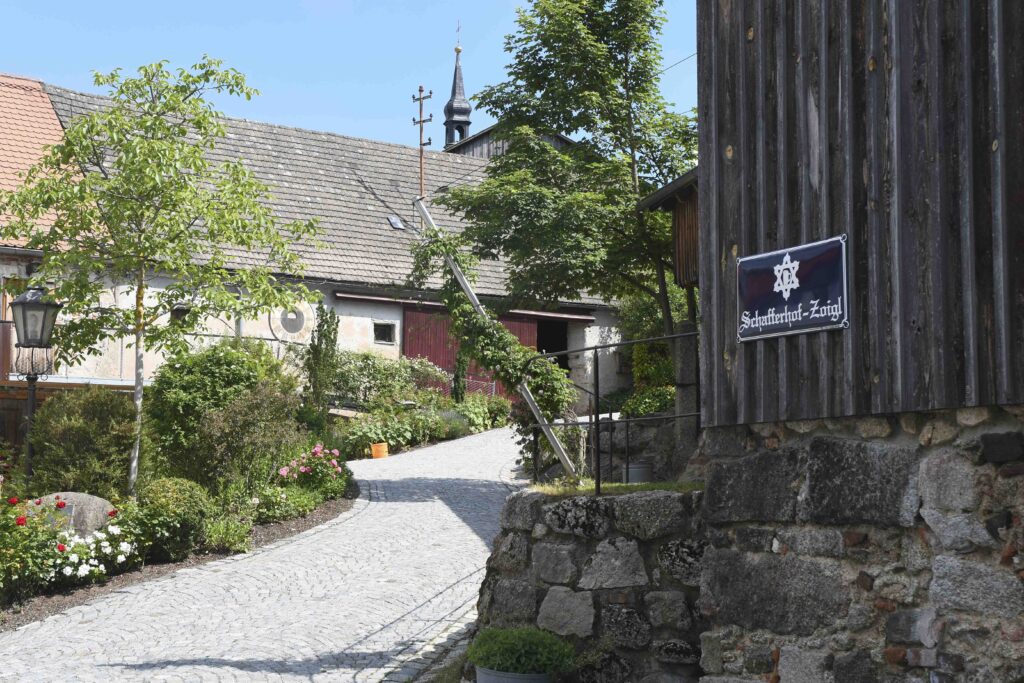
After Teicher, I wander around town and notice that the gates to Schafferhof Zoiglstube are open, with many people drinking in their attractive, terraced biergarten. So I wander in and get myself one, too. This is by far the prettiest beer garden I have seen in the area, a real garden with flowers, trees and landscaping, and a pavilion set up across from the quaint, old warehouse that serves as the fermentation cellar.
This is indeed a special event–they are hosting a home brewers club, which I come to understand as they break out their home brews to share. As many of them are speaking English, it seems they might be Scandinavian. No one speaks to me, and I finish my zoigl, one of the best of the trip, pay, apologize for crashing the party, and move on. No one complains, even though I obviously didn’t belong there.
Schafferhof Zoigl is glowing orange and effervescent, with a high, rocky head. It has a nose of lemon-orange sherbet, honey, biscuits, and bready malts. The lightly tangy flavor is rich with Munich-like malt, a tiny bit of caramel and a vibrant peppery hop finish, tingling on the tongue. It’s quite Czech-like. Süffig and delicious.
Falkenberg
After a typically enormous Bavarian hotel breakfast the next morning, stuffed full of meat, eggs, and cheese, I call a taxi to take me to Falkenberg to try Kramer-Wolf Zoigl. Taxis are quite rare in these parts, and they are expensive. The 12 km by road costs me nearly €40, but this proves well worth it, as the driver, who speaks English, shares recollections of zoigl from his youth. When I mention that zoigl was the reason for my trip, he says, “30 years ago, the zoigl here was horrible. It was completely flat and served far too warm. The smell was nasty and it tasted really dirty. Nothing like the nice stuff they make today. Of course, after you drank four or five of them you got used to it and then it tasted okay, but until then, terrible.” I imagine this zoigl was infected due to bacteria living in those wooden vessels I saw in the photos. Since he expects a slow Sunday, he gives me his phone number in case I will need a ride back. I will.
The brewing towns made an effort to increase zoigl-related tourism in the early 2010s, including a festival-like Zoigl Day in which all communal brewers released their beers at once. It seems this didn’t work. The brewers, who were used to serving their beers once every four to five weeks, were unable to quickly adapt to the new schedule, the results being that many beers at the event that were not quite ready to drink, and worse, that many pubs had no zoigl for their regular customers the next month. Zoigl Day has since been discontinued.
The Upper Palatinate isn’t much of a tourist destination. There were some German cyclists peddling their way around the area, and the aforementioned group of homebrewers, but everyone else I ran into were locals. There aren’t many tourist attractions nearby, and the public transport is meager. The landscape is quite beautiful, however, and there are dedicated bicycle trails everywhere, so renting a bike and seeing a few other towns is probably the best option. Unlike Japan, it’s perfectly legal and also common to ride a bicycle after a couple beers–or possibly radlers–which literally means “cyclist” and was invented so that riders could drink more without getting intoxicated. Mixing Echter Zoigl with lemonade, however, seems like a sin to me. At any rate, with taxis rare and prices as high as they are, it would seem that cycling is the best way to get around in the area. If you mix cycling with beer you’d better be cautious, of course, but having bike roads with no cars on them certainly minimizes the danger.
I arrive in Falkenberg (Falcon Mountain) early on Sunday afternoon and Kramer Wolf is completely full. No seats are open out by the road, so I go into the front room, which is also packed, take a seat at a table occupied by five elderly folks, and proceed to down three pints of my best zoigl yet. It’s very much like an unfiltered Czech pilsner. They were serving luscious hot food for amazingly low prices. Everyone inside was gorging themselves on schweinshaxe (roasted ham hock) and sauerbraten (marinated meat) and the like for only €7-8 each. I’m still stuffed from breakfast, so only order a wurstsalat, which is basically bologna and onions in vinegar, although even that was too much.
A woman in her late 50s or early 60s is handling all the beer, running it out like a demon. Mine is placed before me without my asking. Another arrives once the first is finished. Same with the third. I have to stop after that, though I’m tempted to go for more–should have skipped the food. The majority of the customers here are elderly, though many whole families are here as well. I do what I can to speak with the people at my table, who seem genuinely interested in me, and yet also quite happy to poke fun of me in their local dialect. They are kind, and I wish I could speak better German. I doubt if many tourists come to these zoiglstube. The response of the woman next to me is quite humorous: “No. We NEVER get tourists here.” Well, I guess I don’t count any more once I spoke to her in something resembling German. Zoigl truly is a community thing, as there is practically nowhere else to go out for a drink, a meal, or conversation in these small villages, where farming seems to be one of the few employment options and most young people leave for the cities to get work.
Kramer Zoigl is hazy amber-orange with a tall, pillowy head. It has a spicy hop nose, with oranges, rich biscuit malt, and a touch of butter and toffee. There’s a sweet, oily flavor, with honey, orange, toffee, and a touch of diacetyl–which seemed too much at first, but after two sips I felt it was the perfect amount. This is very Czech. It has a soft body with light carbonation but enough to prickle your tongue. The peppery finish works very well with the bready malts. Nearly perfect. Best so far.
My table-mate points out a man at the next table who has a small wooden barrel of Kramer Zoigl to take home with him. Despite my great joy in drinking this beer, I am suddenly quite envious. If only I could take one back home with me!
From Kramer Wolf, I stroll over to check out the kommunbrauhaus. This one, situated at the foot of Falcon Peak itself, is much larger than either of the first two. I then take a walk around the town, thinking I should call for my taxi when I notice that Wolfadl Zoiglstube is also open. Excellent–this one was not on the calendar for the week! When I stop in, there are only a handful of people there, probably because they had no hot food (or maybe because Kramer’s zoigl is better?). Over the next hour, another fifteen people stop in, and it gets to be quite lively. The beer is decent but it seems a bit too young and green, and not remotely comparable to the lovely brew served down the street. The outside space is very comfortable, though, and the pub itself, charming. The people are nice and they happily call my taxi for me when I am ready to go. I wonder if the zoigl is better normally. As this is not their scheduled weekend, maybe it hadn’t had enough lagering time.
Wolfadl Zoigl is a pretty orange-amber color, slightly hazy, with a high, pillowy head. It has a malty, grainy nose, that’s somewhat worty and doughy–like the aroma of a brew day–plus light herbal hops. There’s a sweet and slightly worty flavor–it seems under-attenuated. Orange and lemon, grass, a touch of caramel, apple, and a slightly peppery finish. The taste is better than the nose, but still a little green. Very bready, like pumpernickel, with some chocolate. I would like to try it after a couple more weeks.
Goodbye to Zoigl-land
Back in Neuhaus I return for another pint at Teicher before tasting my final Echter Zoigl of the trip, at my hotel’s patio.
Waldnaabtal Sausewind Zoigl is the least impressive of my trip. Medium orange-amber and cloudy, it sports a low, thick head. The nose is oranges, lemons, honey and biscuits. It’s on the sweet side. This is rather simple and a bit too low on the hops. Decent enough, but not particularly special. I decide on a schnapps for my second drink.
Monday morning I head to the station for my train to Regensburg. I must admit that I’m looking forward to being in a lively city with more things to see and food that isn’t pork. The zoigl has been fantastic, but two full days alone in the countryside with few chances for communication has been enough. I’d like to return to Windischeschenbach, as there is much zoigl that I have yet to try, but next time, I won’t come alone.
In front of the train station stands Wurth Brewery, so I stop into their shop and pick up four bottles to go. All are branded as zoigl, including a zoigl bock and a zoigl dunkel. When I sample them at my hotel I’m disappointed. They are nothing like real zoigl. The Scherdel Zoigl and Bischofshof Zoigl I try in Regensburg are slightly better, but they too are average unfiltered lagers just trying to capitalize on the zoigl brand. There are several breweries in Germany that use the name zoigl, but only the stuff brewed in the five communal brewhouses is authentic. Some of these seem quite disingenuous. Others who use the name, like Gänstaller (whose Zoigl and Golden Smoked Zoigl are truly fantastic beers) and Zoiglhaus (in Portland, Oregon), which actually holds communal brew days, clearly aim to pay homage to the tradition, although these are not real zoigl either. Hopefully zoigl will eventually get protected status under the E.U., like champagne or gueuze. It doesn’t have such status now.
Visiting Zoigl-land
Getting to and from zoigl country is quite simple, though it takes a bit of time. The most important thing is timing. There are hotels or restaurants in many of the zoigl towns that serve it all year round, but truth be told, these tend to be less interesting than the traditional zoigl houses. In Windischeschenbach, Neuhaus, and Falkenberg, there will be at least one pub open every weekend, but this is not always so in the other towns. When planning your trip, you should download the Zoiglkalender, which gives comprehensive information for the whole year.
The best base for visiting various zoigl houses is either Windischeschenbach or Neuhaus. Windischeschenbach station is easily accessible by train from the great beer cities of Regensburg (roughly 1:15), Nuremberg (1:30), or Munich (3 hours), and is only four hours by train from Prague. There are a few hotels in the towns, two of which serve zoigl year-round: Weisser Schwan and Zum Waldnaabtal. Airbnb is also an option. Remember that most zoigl houses are only open one weekend per month, Friday to Monday. There will usually be just one house open in each town every weekend, though if you are lucky, you may find more. A day trip from Regensburg is also possible, but keep in mind that there is just one train per hour.
There are many great ticket options in Bavaria, especially for people traveling in small groups or families. With a Bayern Ticket, the cost of a single-day round trip from Regensburg for four people is just twice the price of a one-way ticket for one! If you have extra time and come by train, you might also consider a stop in Waldnaab and/or Weiden, two stations on the way to Regensburg. Within walking distance of each station are pubs serving Echter Zoigl brought in from Windischeschenbach or Neuhaus.
If you have come this far, you must definitely stop in Regensburg. It has a world-famous cathedral and a beautiful old town. Kneitinger Brewery is a fine old brewpub in town, and its dunkel is one of the best in Germany. Spital Brewery has a scenic biergarten right on the Danube River and serves a wide range of good beers in view of the river and cathedral. Nearby in Laaber is Plank Brewery, a favorite in Japan, known around the world for its excellent weizens. South from Regensburg, it’s a short train ride to Kelheim and Weissbierbrauerei G. Schneider & Sohn. From there, a short bus and boat ride bring you to Klosterbrauerei Weltenburg, a scenic monastery that has been brewing for nearly 1000 years. Passau is another beautiful old city downstream on the Danube, near the Austrian border. Despite losing two venerable breweries since 2008, it still hosts two others, including the lovely Hacklberg. For a beer lover, there’s no shortage of interesting places in the region. Hopefully most of these breweries and pubs will survive the Covid pandemic and open up for us when we are free and safe to once again hunt for great beers in the German countryside.