



Stories about how craft breweries start always involve adventure, but few seem as wild and unlikely as One Drop’s. The free spirits behind this small brewery in Botany, a suburb of South Sydney, Australia, certainly took some crazy risks and benefitted from turns of good fortune along the way. What would you be willing to do to get a business dream off the ground? Would you sell your family home?
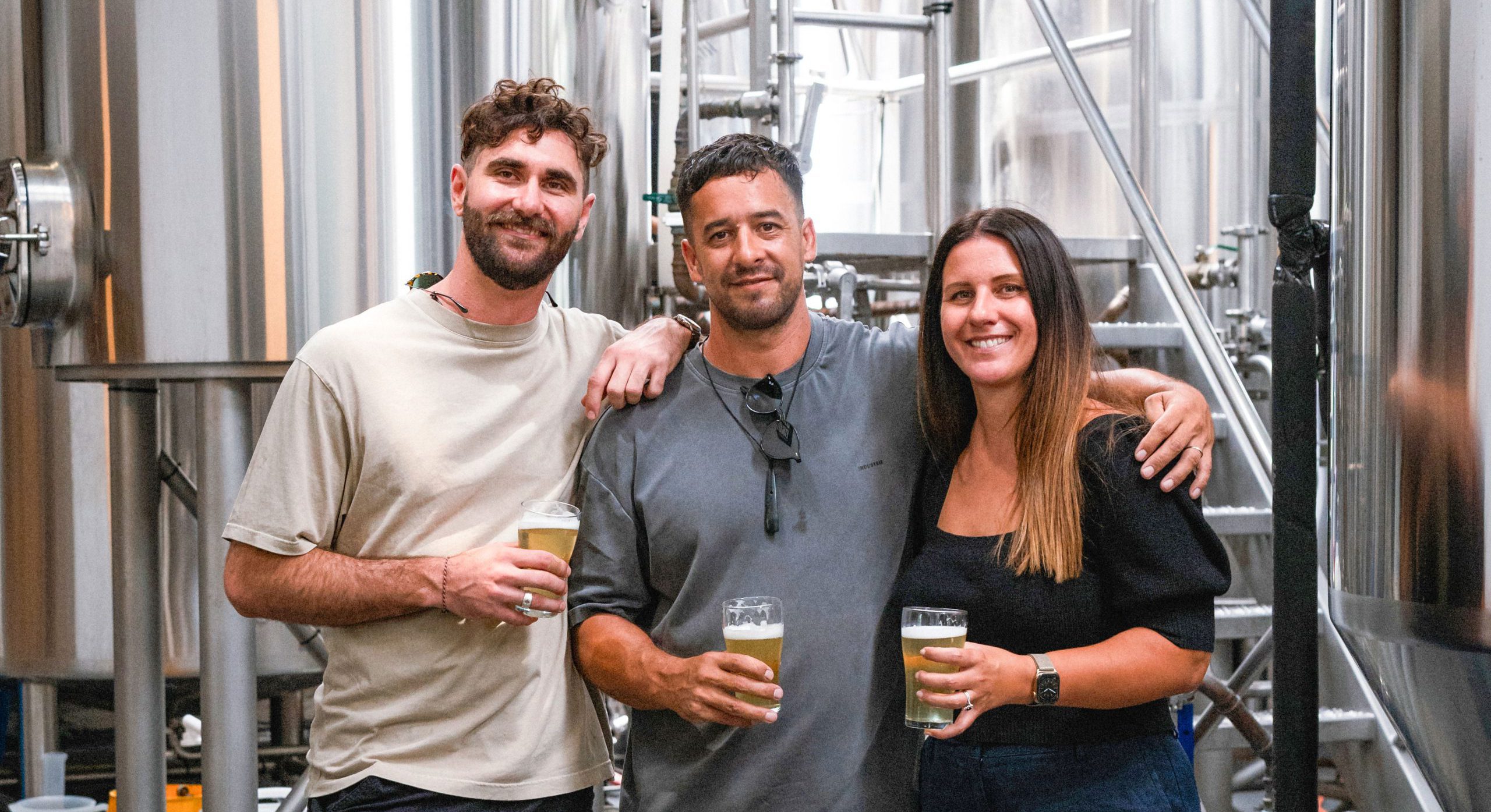
One Drop is run by husband-and-wife duo Clay Grant and Meg Barbic, as well as brewer Nick Calder-Scholes (hereafter referred to by their first names). The brewery’s name is a nod to the “one drop rhythm” of reggae, where the anticipated strike of the first beat is dropped. The couple loves reggae music, but there’s a deeper meaning for them as well.
“When something drops in water,” says Clay, “the ripples expand outward and touch everything. That’s what our brand means, touching families, community–a kind of ripple effect.”
Clay is a New Zealand native who was working on power lines, his employer being his father, before he decided he needed a change from the small town of Masterton (Wellington; pop. ~29,000). He moved to Australia for similar work and there met his wife, a native of Botany.
As Clay tells the story of their beginnings, “There used to be quite a bit of industrial space here, but a little more than ten years ago, it started to gentrify and apartments began appearing. New families like us started to move into the area but there was nothing to do.”
Nothing? Well, there were a couple of pubs, Clay offers, that were still doing “schnitz ’n tits” on Thursdays and Fridays for lunch (the phrase refers to topless waitresses serving chicken schnitzels).
“There were a few blue-collar men’s bars around here, which is all cool, but no place for me, Meg, and our three young kids.”
You can see where this is going. Every growing neighborhood needs a good brewpub. An important catalyst came when Clay quit his power line job and went well outside the box by his own admission, getting into catering. That was 2015. His work involved roasting pigs and lambs on spits, the popular Batch Brewing Company in Sydney being among his first clients.
“After doing that and discovering what a brewery is and how it works, I went home to Meg and said, ‘Hey, I’ve got an idea for something we can do here in Botany.’”
The first problem—a considerable one—was that nobody was willing to give them any money to fund something they’d never done. Their only solution was to sell their house, which they did in 2017. Three young kids don’t need a house, right?
“It was very naive,” Clay laughs. “Some would say stupid. But we made a little money on our house sale, actually, and we thought, ‘Let’s let the money rest for a bit and take our kids for a little overseas holiday.’ We went to Croatia, where her parents are from, and based ourselves there as we traveled around and spent a lot of family time together. It was amazing—the trip of a lifetime.”
Clay used the time in Europe to visit a few breweries, but then two days before returning to Australia to embark on the impossible, he checked out a brewery in Zagreb by the name of The Garden. He learned to his surprise that the brewer there was a fellow Kiwi who had previously brewed in England, so he swung by again the next day to meet him and get a brief tour. The brewer didn’t seem convinced when Clay told him he was going to open a brewery near Sydney.
Clay recalls, “When I went back to where we were staying, Meg asked how it was and I said, ‘Great! I met our head brewer. He just doesn’t know it yet.”
They packed up, returned to Sydney, and several weeks later found the warehouse where One Drop is currently located. It was dilapidated by Clay’s account and needed considerable rehabilitation, but they signed a fifteen-year lease and got to work. Clay messaged the brewer in Croatia—Nick—and told him that they had signed the lease if he was interested in a big change.
“I didn’t hear from him for a good six weeks because he was traveling in India,” recalls Clay. “But when he responded in January with ‘Hey Clay, I’m interested, let’s chat,’ I turned to Meg and said, ‘We got him’. From then on, we worked together remotely on how to put the brewery together as he finished up his work in Croatia.”
Hiring a brewer after such brief interaction to run a brewery that you’ve funded by selling your home is a bold risk, to say the least. Was there incredible rapport from the start?
Clay replies, “I don’t know, but I’m intuitive and when I get a feeling about something, I run with it a little bit. Sometimes I don’t know what I’m running toward, but other times, it feels natural. It was a leap of faith.”
In early 2018, their equipment was on its way from Canada and the couple was doing major infrastructure work on the brewery space. They decided to fly Nick over to meet again and see the space.
“The first night he got in, we met at a hotel down at the beach and got absolutely blind (drunk),” laughs Clay. “That was a telling thing, if you can get on with somebody like that and they’re not a dickhead. We went out, had a good time, and played pool until three in the morning. That following week, we worked together, hung out at the beach, and became friends.”
While it’s fortunate the chemistry worked out in their relationship, there were big problems elsewhere. With the equipment on the water and several hundred thousand Australian dollars invested in the project, they still hadn’t gotten official approval from local bureaucracy.
“It was funny at the time,” Clay laughs, as if it’s no big deal, “because the federal government then changed the zoning for where our building is to ‘ports only’, meaning the endeavor had to do with the port. We freaked out, thought we were done—we had all this money invested.”
IPAs have everything to do with the port, right? India Pale Ales, after all, have their genesis in England shipping the beers to India during colonial times. Of course, this is not a sufficient excuse for Australia’s government, but Nick and Meg made desperate appeals, noting that they had already turned their local application in. Federal authorities thankfully made an exception for them.
“The process was a bit of a nightmare,” Clay says now with humorous nonchalance, “but we were eventually able to open the first weekend in January, 2019, which was cool because 2019 is also our postal code.”
The hard part—running the brewery itself—was about to begin. Clay claims that they had no idea what they were doing, but figured it out along the way with resourcefulness and, of course, Nick’s experience. A big break came as it so often did for them via something unexpected.
Clay laughs, “We have a Kellogg’s cereal factory here in Botany and some employees came down for a drink one day. We got to chatting and they suggested we do a collaboration. We made a cornflakes nitro milkshake IPA, had the Kelloggs logo on the beer, and it went nuts. Nobody had ever seen anything like it down here.”
One Drop even fielded calls from Japan from people who wanted it. There was considerable negative media attention, too, with people claiming they were targeting children, but overall it was a boost for them. That first year also saw them win three golds at the Australian International Beer Awards (AIBA) for their blueberry sour, lager, and XPA.
“It was a bit of a surreal moment,” recalls Clay. “That was the first time we’d been to anything like that and we didn’t know anybody. We weren’t from the Australian brewing industry or hospitality, and nobody knew us, either.”
As Clay explains it, it was common for brewers to leave an established brewery to start their own, taking some followers with them. Like other craft beer cultures, that creates some excitement and the pattern continues. Many breweries make a core range of a few beers, and few step outside that box. Clay, Meg, and Nick, however, reckon that their path was a good one to take, allowing them more freedom.
Clay says, “When we started, we did a 6% passionfruit sour beer, and people thought the abv was too high. Others asked why we were making a milkshake beer. There was a lot of that. But we just thought, you know what, let’s continue on our own path. We’ve since evolved into trying to create an experience around what we make. We enjoy people drinking thick smoothie sours and being blown away.”
COVID actually created an opportunity for them in a country where lockdowns were about as rigorous as Japan’s. When news of lockdowns came, they went to a local pizza joint and sort of laughed it off because there was nothing they could really do. They had two beers in their tanks that Clay called “pretty out there”, one being a nitro pastry stout.
“We were just like, ‘fuck it’,” says Clay. “Let’s do some crazy shit, let’s have a crack. We made a double-vanilla custard nitro pancake thick shake IPA. That sort of kicked it off for us. It was an experience. People were buying it online and we thought, ‘Let’s just keep going.’ We started doing release after release. People at home had nothing else to do and had money in their pocket so they started buying One Drop beer online. That’s what molded us into what we are. It forced us down a path we were already going down, but made it a lot quicker.”
These days, One Drop is generally regarded as a pioneer of such thick, fruity sour beers in Australia. Without any background in brewing, Clay and Meg came up with concepts, rather than targeting popular styles, while Nick executed the brewing. They sit together and formulate beers. Meg, for example, wanted to do a gray-colored beer.
“It looks like concrete,” Clay laughs. “There’s a lot of that kind of stuff. Nick is a great chef. He’ll put it all together and make it work.”
It wasn’t just that the beers were a novel experience; they were clearly good, as consumer feedback indicated. While they originally catered to locals, Nick found a distributor in Melbourne and as soon as they took on One Drop’s beer, popularity started to ignite there.
Clay jokes, “Then it was like Sydney and New South Wales thought, ‘Well, if Melbourne thinks your beer is okay, we’re going to start buying it, too.’ It worked like that at the start.”
During those heady few years, the team grew with Clay and Meg hiring professionals to handle tasks like sales and marketing, but then the momentum stopped. The growth in staff, the efforts to create processes for the business, weren’t working as they had hoped. Clay admits that they didn’t believe in themselves enough to do some of the work and put their trust in others without the eventual results they had expected. One Drop scaled back. Today, the core team is Clay, Meg, and Nick still, but there is a production manager and three brewers that Nick oversees. Clay and Meg handle taproom staff and logistics, with Meg running national sales and Clay handling exports.
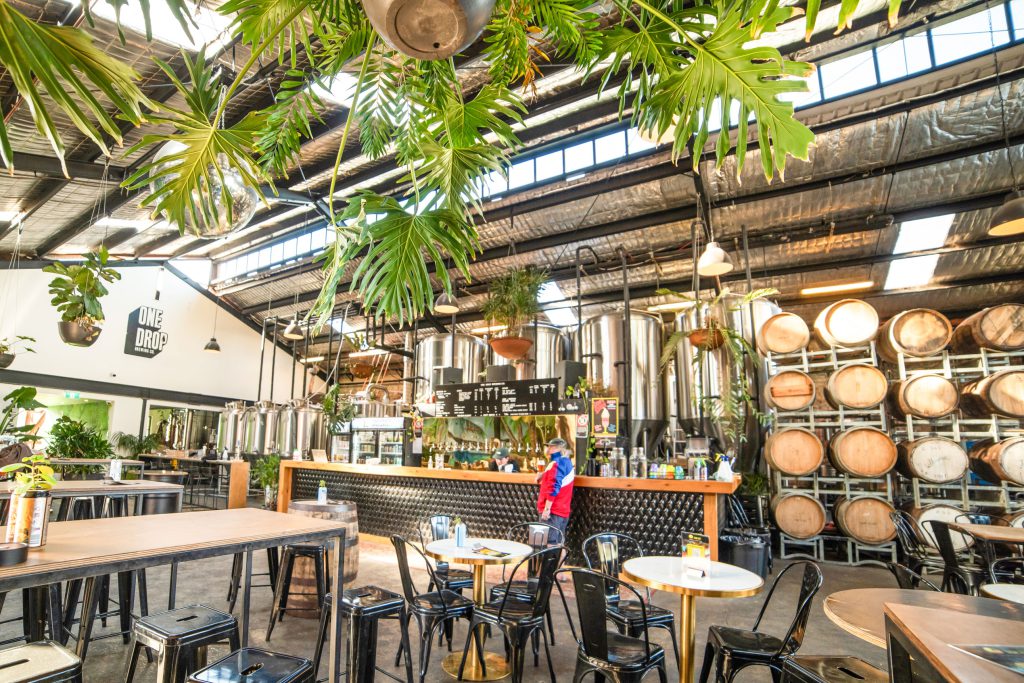
The taproom looks something like a tropical greenhouse with an open air feel, lots of light, and lush plants. Clay and Meg invite different food trucks each week because there’s not much variety of food in Botany and they want to treat their locals to something different. The thick smoothies and sour beers are a delight to customers in such an environment, but these beers aren’t all that they do.
Clay explains, “We do this thing with our lagers where we strip back the water to a neutral pH, take some water profile from around the world, and then recreate that local water source by adding the minerals.”
For example, they created a Spanish lager using the water profile from a river in Barcelona. When a customer came in from Barcelona, she claimed it tasted exactly like a Spanish lager from back home. They’ve done the same with a Czech pilsner and an Italian pilsner. True to their name and their soul, they even created a Jamaican lager, Wah Gwan, using a water profile pulled from a river there.
As noted above, Clay handles exports and Japan is their oldest export market. He discovered importer Laff International online and scoped them out before making contact. It’s been a good fit, he says, and he’s curious about Japan’s vibrant reggae scene. He notes that New Zealand unexpectedly had a huge reggae following as he was growing up, too.
While they enjoy export growth, their plan at home is to simply max everything out at their current location. They’ve had to start brewing their core lager and hazy pale ale at a facility elsewhere, which allowed for more room in their tanks for “interesting stuff.”
“We’re already starting to burst at the seams a little here,” admits Clay. “If a sugar daddy wants to invest a lot of money in us, we could go to the next step. Otherwise, we’re happy at the size we’re at now.”
It seems they are content not to have to sell their home again.