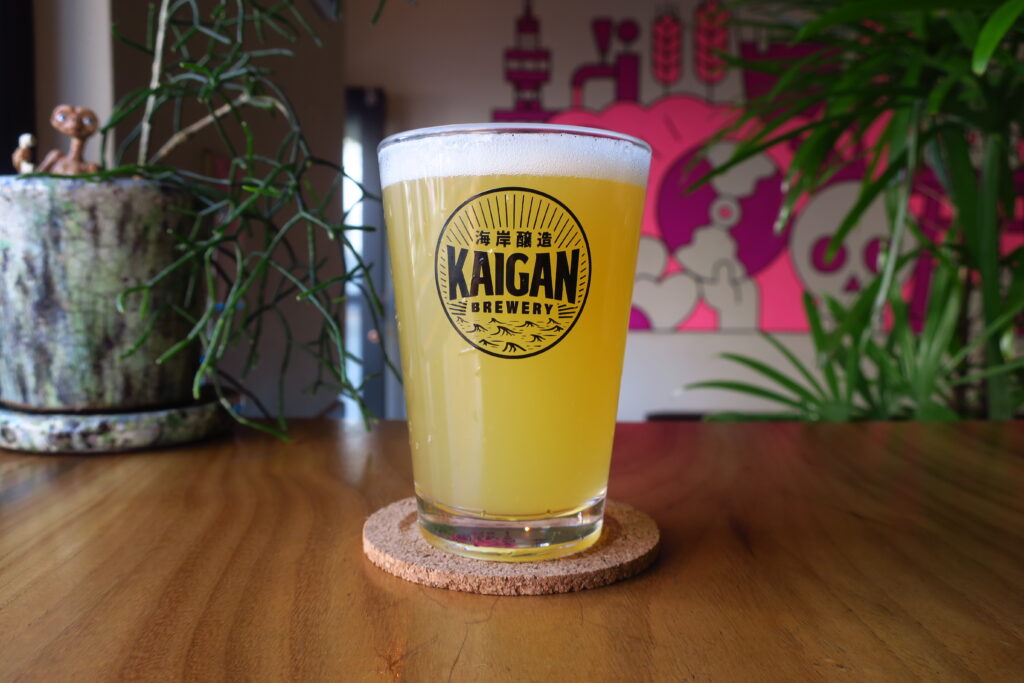
As avid surfers, Philippe Gueulet and his friends felt that being able to bring home some local beer to enjoy after their trips to the Chiba coast would make a fitting end to their fun. If you’ve ever engaged in any kind of beach sport, you probably understand the feeling. There are certainly worse reasons to open a brewery, which is exactly what they did.
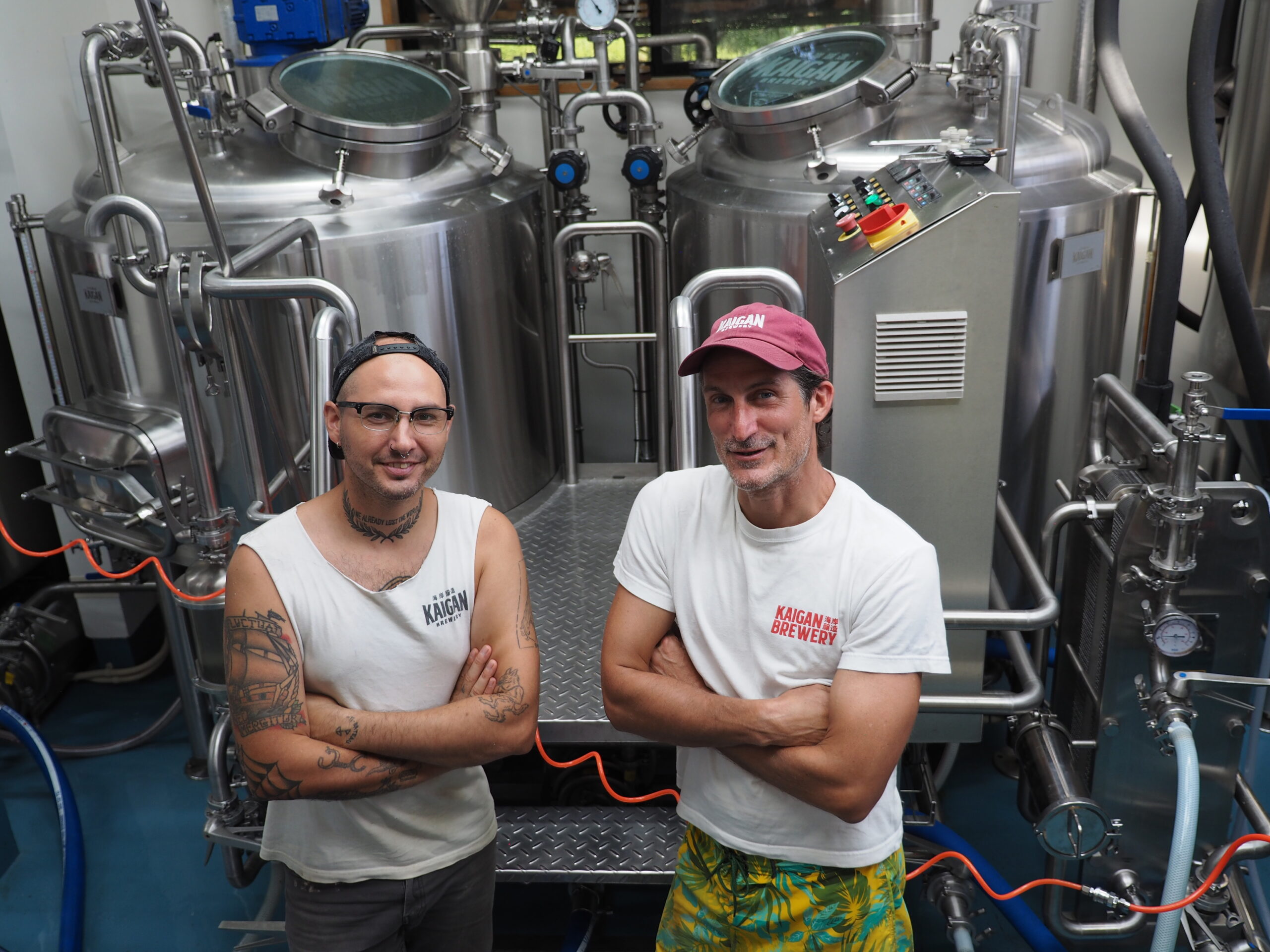
Gueulet has a distinct resemblance to the actor Woody Harrelson. His almost mischievous, boyish smile is what does it the most. He is smiling throughout our interview, in fact, as he should be given the dream he brought to life. He is the cofounder and co-owner of Kaigan Brewery, on Chiba’s Pacific coast, and also the taproom Coaster, with two locations in Tokyo (Shimokitazawa and Aobadai).
Please share Kaigan Brewery’s origin story.
Starting from the beginning, our business, called Coaster, Inc., is the result of a drunken discussion at a craft beer place in Shibuya.
That’s funny–that’s how the Japan Beer Times began…
(Laughter) I had always been passionate about beer and beer making, and was doing some of my own brewing. I wanted a brewery! But before that, I met the manager of Ol in Shibuya who introduced me to a friend of his that wanted to start his own restaurant—he had been a chef at another restaurant in Aoyama previously. We were drinking and talking, and decided to do it together. ‘Hey, let’s launch a restaurant and taproom, and then later down the line we can add a brewery!’ Later, once we were sober, we got together again and put together a business plan. That was the first Coaster—a pub with craft beer—and that opened in Shimokitazawa in February of 2019. It was not an easy start because it was right before COVID hit, but we survived and built a little community in Shimokitazawa.
And then after that, true to the dream, you launched the brewery?
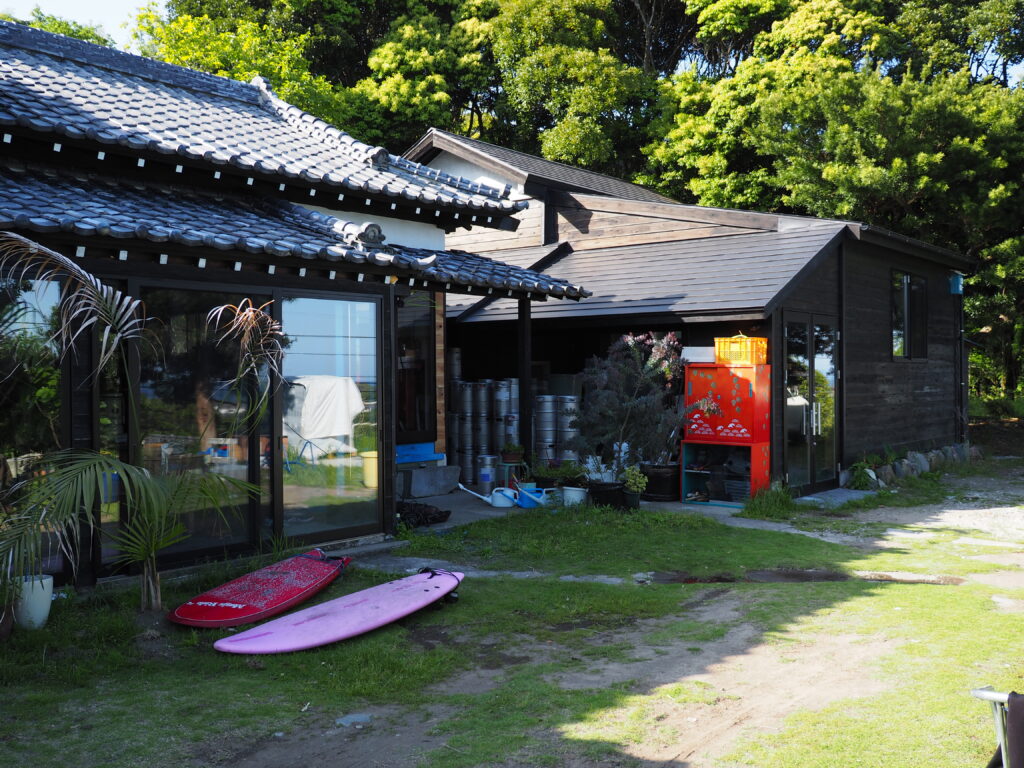
Yes, during COVID I was kind of bored and said that we should accelerate the brewery project. I had previously bought a kominka—an old, traditional Japanese house—in the Chiba countryside near the coast and we decided to use that. One of us was always going on the weekend, sometimes during the week, to go surfing.
A kominka for a brewery! I guess you had to do some restoration to it, correct?
Yes, the house was built in 1898. On one side of it is a kura (a traditional storehouse) that was falling apart, but we decided to revive it and extend part of that structure to put the brewery inside. We did our best to keep the traditional structure intact as we put in all the equipment.
And you handled the paperwork?
Everything dealing with bureaucracy is me. Getting the license was a bit of a challenge because none of us were Japanese, though I’ve been living in Japan for twenty-three years now. We started the construction in late 2020 and got the license in January of 2022, when we brewed our first batch.
How did that go? The first time is always… delicate.
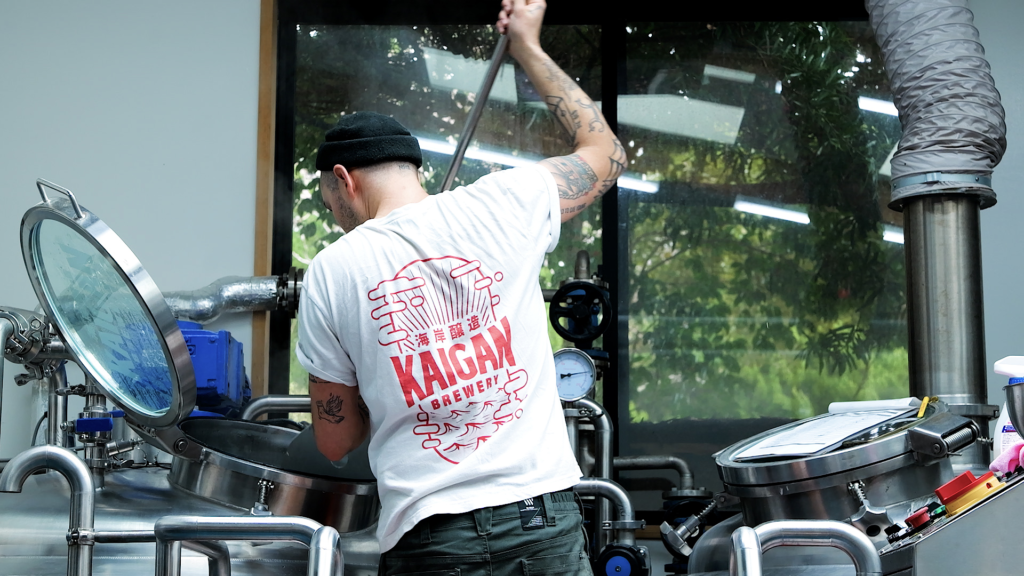
Honestly, the first few batches were not so great. Mehdi Djerrah, who is our head brewer now, used to be a chef at Coaster and was really passionate about beer. He went back to France to study brewing for a year and when he came back, we opened Kaigan together. But we didn’t have so much solid brewing experience on that level of professional equipment at the time. In the beginning, we got help from Chris Poel at Shiokaze Brewing. He’s a good friend and we brewed some batches with him on the new system. Our skills steadily improved after that.
That’s certainly important for business!
Kaigan is more of a passion project than a business one—of course, if you don’t have money, it won’t sustain itself! But we are not doing this solely for profits. We want to brew beers that we enjoy. And so we brew a lot of sour beer, actually. Hopefully people will like what we brew (laughter). We’re always trying to experience new things. We are in the middle of rice paddies, and there are lots of farmers around. We receive fruits and vegetables from them which aren’t suited for selling at stores because they are not shaped nicely.
What are some examples of the produce you get?
Every year we do a sour ume beer (usually called “plum” but technically Japanese apricot). We do a yuzu beer every year. And we brew with persimmon. The strangest one we did, which was actually a great success when we participated in the Lyon Beer Festival in France, was our shiitake (mushroom) porter. It wowed everyone. It’s surprisingly good because you don’t have the taste of the shiitake after the boil.
You get all the umami flavor.
Exactly! You have the umami. Even people who are not a big fan of black lagers, porters, or stouts say it’s good. We are looking forward to doing it again this year. We have another fantastic seasonal we’re going to do again this year that’s a blueberry sour. For a five-hundred-liter batch, we put one-hundred kilograms of blueberries in.
What’s your base beer for the persimmons?
We do a hazy IPA with that. It came out a beautiful orange color with no oxidation.
Are you souring in barrels or dosing with Lactobacillus?
We do kettle sours. We tried other ways of souring our beer but this was the most elegant way for us. The taste is more complex. We always use natural grains. We put them in sacks and dip them in our kettle during fermentation. It’s a really natural way. It always takes three days and it’s a constraint on production time, but we don’t really care about that. We care about making good beer.
I guess you surf during the days you have to wait.
(Laughter) Yes.
You mentioned being in Japan for twenty-three years. What have you been doing?
I came for the first time on behalf of a company in southern France that was exporting truffles to Japan. After working here one year they wanted me to return, but I liked living in Japan. I wanted to challenge myself a bit more by working here. I then worked for another French food company for about ten years, and for the last two, I was their commercial director. Then I joined the major consumer goods company Johnson & Johnson for eight years. Now, I actually work for Red Bull in Japan.
No Red Bull sour beers coming up?
No, unfortunately not (laughter). Not yet—an interesting idea.
Also, earlier, you mentioned the Lyon Beer Festival. Can you please tell me more about that?
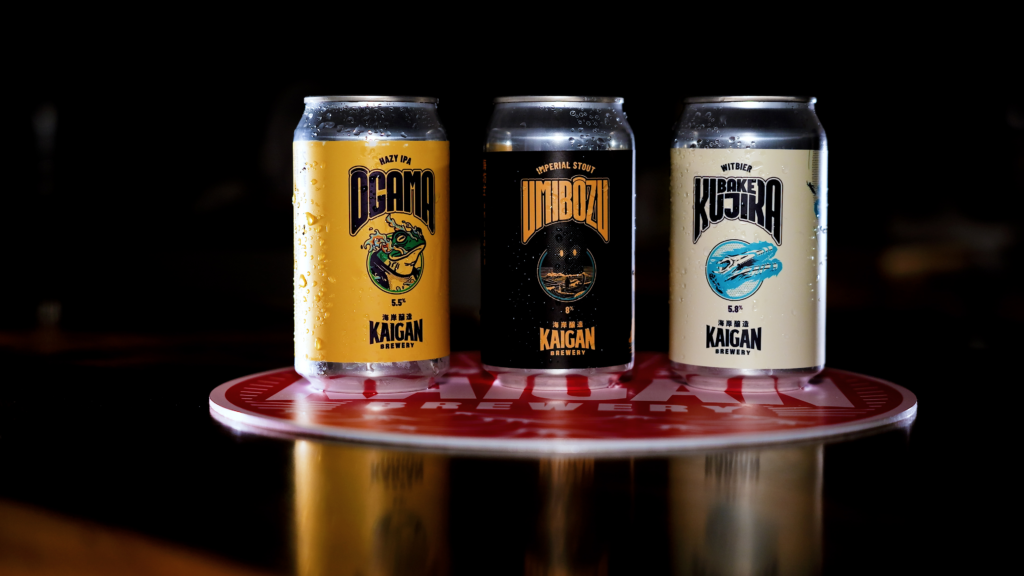
Many breweries have been coming to Kaigan to do collaborations. We love that because it’s a way of making friends. You’re always exchanging techniques. There’s a big brewery in southern France called Prizm, and they reached out when they were coming to Japan because one of the people who organized the tour from the Japan side loved our beer. When they came, they loved our place—the brewery, the barbecue, the surfing. They are also one of the biggest craft beer importers in France through a separate company. When they participate in the Lyon festival, they always bring international breweries to demonstrate their import capability. After they visited and brewed with us, they imported the beer back to France for the festival. They asked us to participate so we went and brought some of our own Kaigan beer as well. Economically, it was quite costly, but people in France were delighted by our beer and our designs. For our artwork, we use yokai—Japanese monsters. Our IPA, Ogama, features a frog with smoke coming out of its mouth. In France, consumers love those traditional Japanese aspects in a modern context. Our beer was well-received there.
Let’s talk about Mehdi. You mentioned he started out as a chef before becoming a brewer.
He first came to Japan to open a falafel restaurant. That didn’t work out longterm, but his restaurant was great, actually. He’s a very talented chef and I think that’s one of the reasons he’s a very talented brewer now. It’s difficult for me to admit this, but he’s a much better brewer than me (laughter). After the falafel restaurant closed, we hired him as a chef at Coaster. We got along very well. When I told him about my dream to open a brewery, he said that his dream was to become a brewer, too. In 2021, he went back to France to study for a year, and when he came back it was six months before we opened the brewery. We decided to do it together. Both of us learned from the beginning how to use that system and design recipes on it.
Besides Mehdi, you mentioned others being involved.
At the brewery, it’s mainly him and me. The company itself, Coaster, has five principal people, two of whom are quite involved in managing the two taprooms and their staff, and three who are passive investors.
Do you sell your beer beyond your Coaster taprooms?
Yes, mostly in the greater Tokyo region. We deliver to Coaster every Thursday and then to other bars and restaurants.
Sour beers are still a little unusual in Japan. You’ve had good reception?
Yes, but our best seller is our hazy IPA I mentioned earlier, Ogama. We also have an IPL called Kintama (“golden balls”), which is an attention grabber because of its name. We originally called it Tanuki no Kintama (“golden balls raccoon dog”), but that was too long. When we went to festivals, people got a good laugh so we stuck with that. We also have a wheat beer called Bake Kujira (“monster whale”) and an imperial stout called Umibozu, a shadow creature that appears in the middle of the night to smash boats in the sea. Our last core beer is Shojo, a red monkey with the ability to make sake out of seawater—that’s our West Coast IPA. Our sour beers are all seasonal and based on what’s available at the time.
Returning to your kominka, you mentioned that as a place you originally bought for private leisure.
Yes, I wanted a place in the countryside not far from Tokyo—something I could renovate and paint on my own. There’s this strange thing in Japan where many Japanese don’t like these old houses. True, it’s cold in winter and hot in the summer, but to me it looks just like an antique. It’s more than a hundred years old! You want to preserve it. It has its own story. There’s a fantastic charm to it. Actually, all the guests that come to Kaigan now—and not just foreign guests—love the beautiful house. Again, it was just supposed to be a getaway where we’d go on the weekends for surfing, or maybe during the weekdays if the waves were good. But now Mehdi lives there three days a week, and I’m usually there three days a week over the weekend
The brewery itself is in quite a rural location, though. What was the local reaction like when you opened?
In the beginning locals were skeptical, wondering what in the world we were doing. But we’ve been working with the local community, using their produce and giving them beer. Once a year we have a festival on our campus and the locals are happy because they don’t have so many community events like that where they can get together. They enjoy having a social gathering at the brewery. One of the farmers raises cows so we give him our spent grain. We try to minimize the waste from our brewery in that way. We use the rest of our spent grain in our vegetable garden behind the brewery—our neighbors now want to use it as well.
Do you have a tasting room at the brewery?
We are in the process of building it and will open this summer. A lot of people told us they wanted to visit and drink here. Until now, we’ve been takeaway. Another reason I wanted to have a taproom and beer garden was that I won a Chiba business competition and got some local press. Now, every weekend we have three or four random people showing up to drink. Organically, we had people coming so I figured we should be more welcoming. We have a little station nearby, Chitose, and we’re only a ten-minute walk through rice paddies from there. There are plenty of accommodations in the area, including some really nice hotels.
I used to do a lot of surfing at Kamogawa myself. Sometimes, with typhoon swells, I’d see that there were huge waves (double overhead) and I’d think, ‘Shit, I have to work today.’ Are there days like that for you, or do you sometimes just say, ‘We’re not going to brew today; we’re going surfing!’?
Even now I’m an early bird. I go to bed at 10pm and wake up every morning at 5am. When there are nice waves, a group of us might go out at 5am in the morning, surf for two hours, have some coffee, and then maybe I’ll start brewing at 8am.
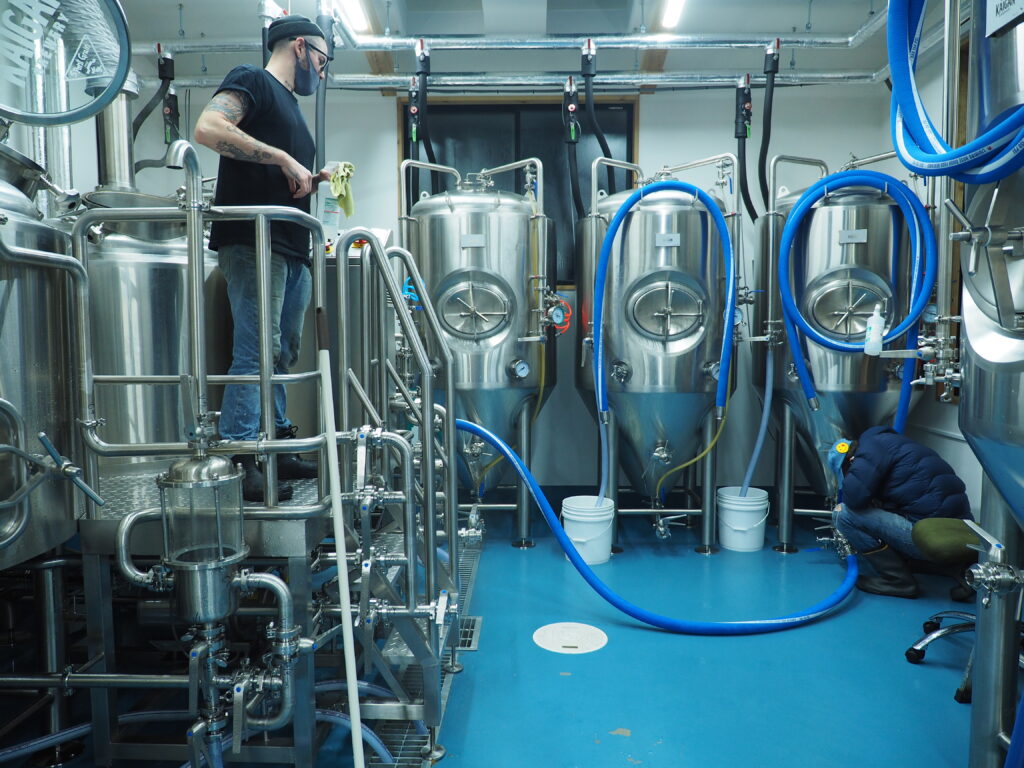
What are your plans moving forward? Your brewery is still somewhat small (five-barrel system). Are you content to keep it that size or do you have expansion plans?
We just finished one expansion—an expansion of the original expansion of the kura. We finished the set-up for a Canadian canning line. We had a manual filler, but people liked our cans so we decided to invest further. We are planning to put in three more ten-barrel tanks for greater production volume.
And Coaster is now up to two locations in Tokyo. Are more in the works?
That’s the plan. With both of our Coasters, it took us between six and eight months to break even. Opening a new taproom is heavy lifting. It’s time-consuming, cash-consuming, and finding staff is one of the biggest challenges. As I mentioned, there are two other partners intimately involved in operations besides me and Mehdi. I feel like they are probably exhausted from having recently opened the second Coaster so let’s give them another year to rest before we do another one (laughter).
Thank you, Philippe. I’m sure your Tokyo area fans are looking forward to that. But hopefully I’ll see you out at the beach one early morning with my board under my arm.