



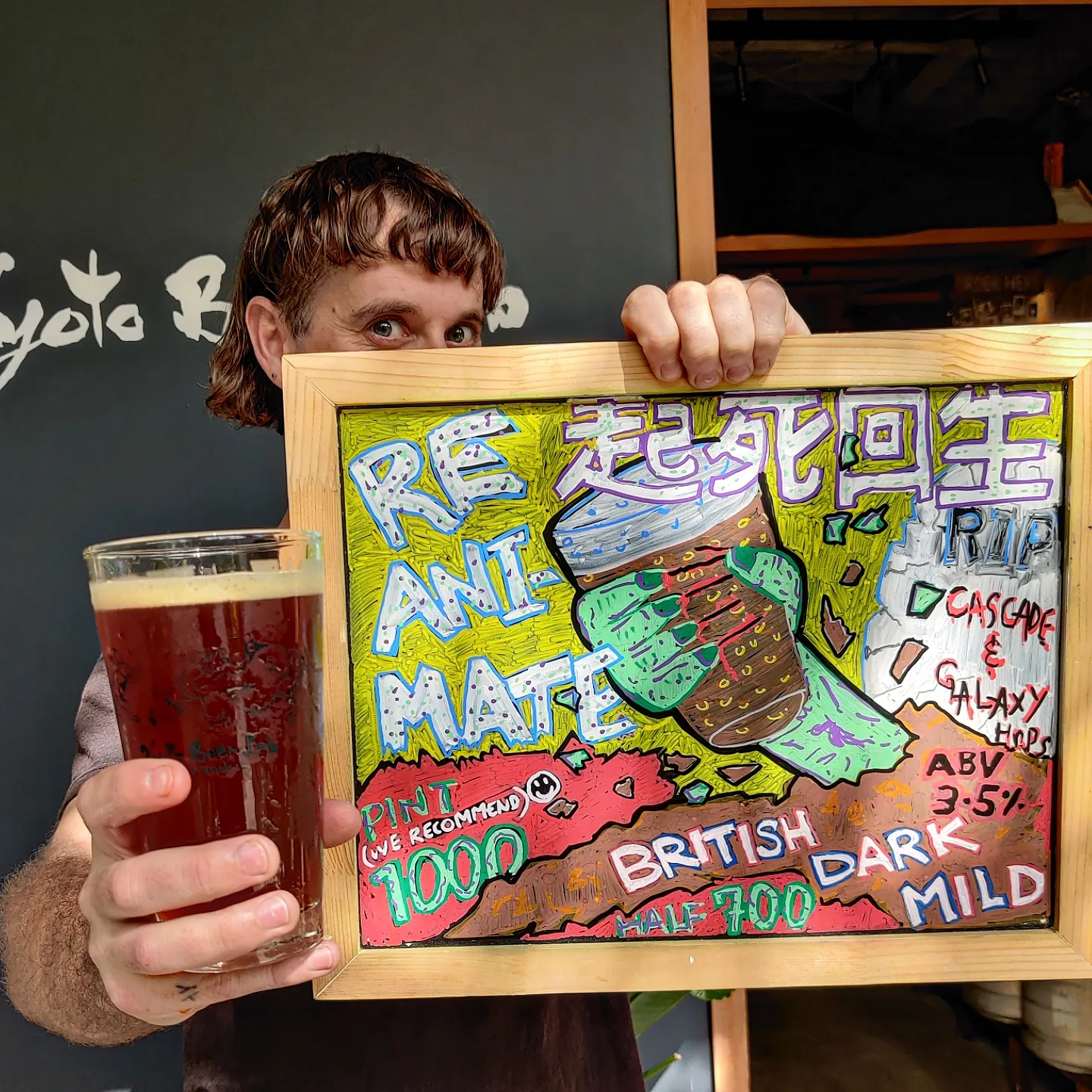
By Tom Ainsworth. Australian Ainsworth is the cofounder and head brewer at Kyoto Beer Lab, hereafter KBL; see feature in JBT35.
How many times have you been on the hunt for a beer, throat as dry as a dead dingo’s donger, covered in sweat as the sun beats down on you, following the directions of Google Maps, your personal pied piper to the nearest watering hole? As you sit down to order a refreshing pint, you are passed a menu with DDHTIPAs, milkshake monstrosities, double fruited vanilla infused POP sours, and an imperial stout darker than the river of Hades. You look up into the bartender’s lactose-ridden eyes and manage to croak out, “Sorry mate, could I just have a glass of water please? I promise I’ll order a beer after…”
The reply comes back, “No water without an order, buddy. Back out on the pavement.”
Well don’t fear, weary beer-expeditionary, the answer is here. Actually, it’s been here all along: the Mild. A beer steeped (brewed?) in history that, while having lost its mid-1900’s popularity, still has a core and loyal fanbase, and is still found being brewed throughout the UK and a few other countries.
The Mild, from the family of English beers that includes the Bitter, ESB, Brown and many others, has an interesting history. ‘Mild’ was originally the term used to separate aged (old) ales from fresh or unaged ones, so there was a mild porter, a mild bitter, you name it. Milds of this time ranged from gravities of 1.050 to around 1.070, allowing for ABVs of up to 7%. During the First World War however, when emergency scarcity measures were enforced, beer makers were forced to restrict their OGs to a max of 1.030, causing a lowering of alcohol percentages across the board.
This led to the Mild dropping to 3% or lower, which has carried over to modern takes of this nearly lost-to-history beer style. The modern Milds will sit between 3-4% alcohol, are mostly dark to very dark, have deep malty flavour profiles, but also go down a charm. This unique balance of drinkability and deep, complex flavours is what makes this such a unique and satisfying drink.
So back to the pavement, no water to be found, one keg kicks and a new beer comes on–the Dark Mild, 3.5%, fully developed flavour profile, dark, and complex. Soft carbonation popping rich sweet malts off the top of a dark white head. A whole pint disappears in one sip, fresh and refreshing, but lacking nothing for the interested beer aficionado.
The Mild is brewed with pale malt, and then layered with crystals, and in the case of Dark Mild there is often an addition of chocolate or black malts. Being an English style, at KBL we brew our Dark Mild with an all English malt bill–Golden Promise as the base, then DRC, Aromatic, and Black malts from English maltster Simpsons. We harden the water a little bit to retain body, then hop to around 15 IBU. Judicious use of aromatic hops as early bittering additions is a trademark of the style, bringing a floral balance to the mild bitterness.
The result: dark fruits, fig, toast, hints of chocolate, big nutty notes. It drinks full and refreshing, belying its low ABV. A periodical feature on the brewpub’s tap list, keep an eye out for Re-Animate, British Dark Mild. Drink it by the pint. It’s the civilised thing to do.
Hunting down a pint of the mild can be a hard job outside of the English countryside. If you’re lucky enough to find a Theakston, buy the shop dry! Otherwise your best bet might be to hassle your local brewpub until they make you one. Local examples of the style include a Pale Mild (discontinued) made by Kyoto Brewing Company using hops from nearby Yosano, and I heard whispers of Y. Market brewing a spiced Mild many moons ago. In the meantime we’ll be showering ourselves in this delicious dark liquid soon at my brewpub. Dead beers never die!