



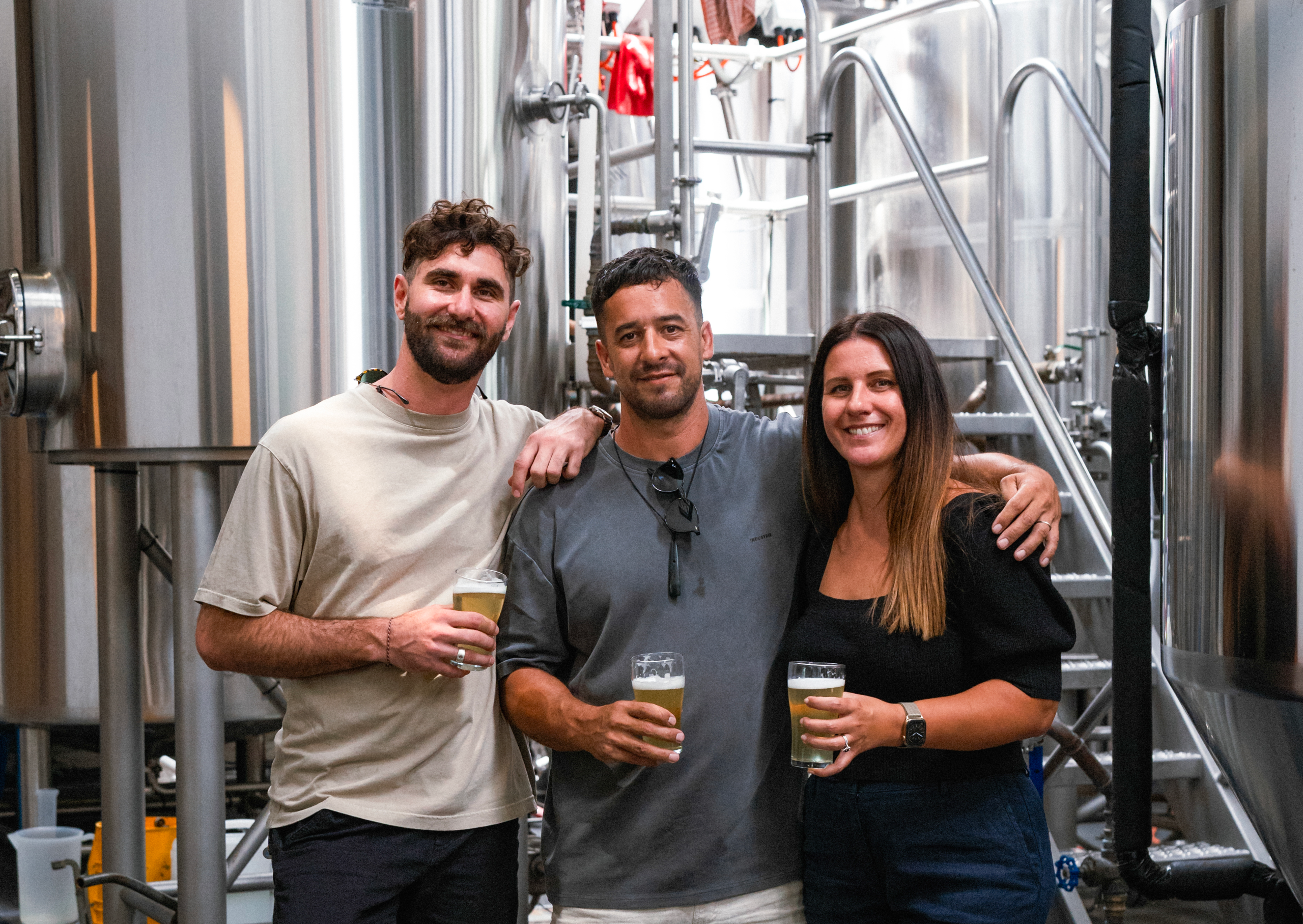
For this issue, we return to the topic of centrifuges. But instead of describing aspects of the machinery, we speak to an experienced brewer about his specific application of the technology. Nick Calder-Scholes is the head brewer at Sydney, Australia’s One Drop Brewing Co (featured in JBT60). Using a centrifuge from GEA, whose systems are available in Japan, he and his team have developed a new brewing process they call Clean Fusion. So far, it has yielded eye-opening (and fan-pleasing) results from their R&D IPA program. Hopefully this practice will spread in Japan, too.
Please describe the basic process behind Clean Fusion.
Nick: It’s a process when you’re finishing fermentation that involves transferring the beer onto the hops via centrifuge. So you have tank one and tank two. In tank one you have your primary fermentation. You use your centrifuge to move the finished beer to tank two only slow enough to remove yeast (depending on your application, you may want to leave some yeast in). In tank two you are purging it of oxygen and dry-hopping. You can process your hops in tank two however you want. That might be rousing, recirculation—whatever you decide to do. Then when the dry-hopped beer in tank two is where you want it to be, whether that be based on time or flavor or any other measurable metrics, you centrifuge that product again into a bright tank, and that clarifies or removes any hop material. You’re centrifuging twice and your beer goes through three stages: end of fermentation, dry-hopping, bright tank. That’s the process. There’s plenty going on in that process that makes it beneficial.
In theory, you could do this without a centrifuge, right, but it takes a lot of time and is prone to error?
Yes, you could cold crash it, or add clarifying agents, but what’s crucial here is to eliminate hop creep and to reduce the amount of hops you have to use for the same impact—those are some of the beneficial things we’re seeing by using our centrifuge. And you need to have the entirety of your second tank below a certain cell count. Let’s say you add your hops and agitate, rouse, or recirculate. You might have a low yeast cell count in your sample, but your cell load could peak again once you agitate that tank. By using the centrifuge you are guaranteeing that every single liter is of a certain cell count. Our standard is a million cells per milliliter. That’s not enough to re-trigger fermentation, but enough to get some biotransformation, if you want to go that route. Breweries without a centrifuge have done it, but the process remains the same: you’re dropping everything out, whether you’re using clarifying agents and transferring off your racking arm, or some other method. And the general goal is to transfer finished beer into a new tank with hops but have every liter of that beer below a certain cell count. You’re not going to be able to do it in the same tank.
The problem with many clarifying agents in Japan, though, is that they are restricted or banned…
With breweries that don’t have centrifuges, you just have to rely on time. You have to work it into the brewing schedule. Centrifuges increase Stoke’s Law, which is essentially the power of gravity. Cold temperatures and time can still get you there, but it will take a long time.
And with a centrifuge you’re going to have less beer loss, too, correct?
When brewing lower-hopped beers, you are able to ‘process’ the bottom of the tank that would usually be left behind in a tank-to-tank transfer. You get greater yield and thus more savings from the same inputs. For hoppier beers, there are other benefits (explained in a moment). Also, through Clean Fusion, you are not dry hopping during fermentation like many brewers do. This means that you are able to harvest the yeast—as much as you need—from your fermentation vessel before transferring. If you are able to harvest and then re-use yeast from hoppier beers, it brings your price down. Brewers dry hopping during fermentation are not harvesting that yeast for re-use because it’s bad practice. With Clean Fusion, sometimes you can get ten generations of yeast across two SKUs—twenty beers from one pitch! A twenty-fold decrease in yeast cost is substantial.
And now we’re really getting into the weeds (laughter). Myrcene is one of the most abundant oils found in all hops, but it’s technically not soluble in beer. It doesn’t dissolve but it can sit in beer. It can be suspended by things like viscosity or yeast cell counts. So you bring clean beer onto the hops, from tank one to tank two, and hop oils are suspended there by the viscosity of the product, and then when you move that to your bright take via centrifuge, you’re removing any plant material. We found with previous beers that if you remove yeast later via centrifuge, refining agents, or by dropping it out, it’s also pulling hop oils and aromatic compounds with it. We’ve found a 20% reduction in hop use in a side-by-side comparison using the fusion method, again, because you aren’t removing suspended hop oil that is attached to other things. We’re seeing a higher intensity of hop character in the product. You may not save on volume, but you can reuse your yeast and use fewer hops, which is the second most expensive ingredient in your beer.
So a centrifuge starts paying for itself…
Yes, you see a decrease in cost for the same product. And if you’re trying to brew really hoppy beer, you could spend the same amount of money to have an extremely hop-forward product. Another benefit is this: the longer that beer sits on hops, the more the vegetal matter starts to leak out high polyphenols—harshness in the beer itself. Being able to have absolute control over timing, like tasting your beer every six hours and being able to notice if it starts to turn a little vegetal or harsh due to phenols, is critical. You can just pull your beer straight from that tank immediately with the centrifuge and run it straight into your bright tank. In short, you’re not only able to reduce cost by reusing yeast and needing fewer hops—which is an environmental concern, too—you’re also able to pinpoint the kind of hop profile you want.
Hops are creating some challenges for brewers these days, especially with hop-forward beers being so popular. Can you please share your thoughts on that?
Hop growers are kilning at a lower temperature and that’s been happening over the last few years. That’s led to extra enzymatic activity, or hop creep. The way that people are hopping beers these days is that you’re still going to get some enzymatic activity when dry-hopping. The key is to not have levels that would re-ferment. The enzymes that create hop creep are still active and working. But with our method there’s no yeast left in the product to ferment that. Hop creep is thus eradicated. Again, that’s why we stick to a million cells per milliliter. There’s just not enough once you reach the second phase of our process. We’ve eliminated hop creep across all of our products, and that’s one of the biggest issues for hazy beer brewers. That’s not just from a sensory evaluation. That’s based on lab testing, too. We’ve verified with our own lab and external labs, as well as through collaborations with some pretty big breweries around the world. We’ve studied how our process is working. We’ve looked to see if there are any consequences downstream like refermentation and alcohol increases. As brewers, we now have full control over our product.
Let’s return to your standard of a million cells per milliliter. Can you speak in more detail about how you arrived at that?
When you produce beer, you need a certain amount of yeast and there are calculators for that. How much you put in can influence things like ester production. Yeast science is already well studied in the context of fermenting beer. When it drops down to a million, again, we found that it allows for some biotransformative activity, but not to the point where you are inducing diacetyl production and lack of re-uptake, which is part of hop creep. We’ve played with five million cells per milliliter and we were still seeing a slow creep. Even at two million there was a little. We let that play out and processed the beer anyway, but the problem was that the beer had been sitting on the hops for too long. We arrived at this number through trial and error. From tank one to tank two, you have a million per milliliter, then your contact time with the hops is forty-eight hours, and then you centrifuge again. Your cell load is so low that by the time you get to your bright tank, there are no cells. If you go from tank one to tank two at five million, then eventually in your bright tank, there’s a chance that cells get through depending on whether they’ve multiplied or the effects of hop creep.
In tank two, there are different methods for dry hopping. What have you experimented with? You know, there are still a few brewers in Japan still dry hopping with whole flower hops.
Oh, wow (smile). Well, with Clean Fusion our biggest experiments have been with temperature. That has a direct correlation to both hop oil solubility and polyphenol extraction. There’s a fine balance between having hops in there long enough for the oils to become soluble and assimilate with the beer, and hitting a point where you start to extract harsh flavors from the polyphenols. Again, we open the top of tank two, dump hop pellets in, then transfer the (finished) beer onto it while removing the yeast. We purge it of oxygen and rouse with nitrogen—you can use any inert gas. You want to push the hops back into the beer. I think the ideal way is if you have one of those hop dosers, like a Hopnik, where you can purge the tank and add hops. You could fill your tank fully, add hops, then pull your beer off. We’ve tried recirculation but we’ve found that it extracts more polyphenol harshness than we want. If you do have a hop doser, it’s the same process: you transfer to tank two, then recirculate your hops until you are happy, then move on.
Thank you Nick.
One Drop is imported by Laff International: http://laff-il.com/