



While malted barley is the main ingredient in most beers, for centuries, for millennia even, brewing traditions all over the world have also employed wheat, malted and unmalted, in the brewing process. South German hefeweizen and Belgian witbier immediately spring to mind as obvious examples. We might also recall Berliner Weisse, which recently experienced a worldwide revival, and Belgian lambic, as other beers containing wheat.
Wheat offers many unique characteristics to brewing. Most importantly, wheat has a higher protein content than barley, and contains different kinds of proteins (which is why it is vastly preferred in baking bread and cakes). In beer, this lends a silky, creamy mouthfeel that is lighter than a 100% barley malt brew. This glutenous protein also leads to better head retention. It has a different flavor than barley, too, offering bready notes and a slight lemony, acid tang. These traits make wheat beers especially refreshing in hot weather. The proteins in wheat make beer naturally hazy, as seen in both hefeweizen and witbier.
Wheat lacks the outer husk that barley has, which makes it much harder to brew with. When emptying the lauter tun after the mash, those husks act as a filter, keeping the solids back while letting the wort flow out. A wheat mash can end up gummy and pasty, so a beer made from 100% wheat is a near impossibility. German hefeweizen must by law contain at least 50% wheat, in this case malted wheat, and most weizens contain some 60-70%. Other styles typically use less than 50%.
We’ve covered hefeweizen, witbier, lambic, and weizenbock in this column previously. All of these, and Berliner Weisse as well, share one striking similarity: although each style of beer employs hops in the boil, none of them are what we would call “hoppy” beers. That is to say, in each case, hops are used for their antibacterial properties and to add flavor and bitterness, but none of these four styles shows a pronounced hop aroma or flavor.
As with just about everything else in beer, with the onset of a world-wide craft beer craze, this has changed. The first change was the emergence of the American wheat ale in the 1980s. This started as more of a riff on a German weizen than a new style. To a similar mash bill, a much cleaner American ale yeast was substituted for German weizen yeast, with a subsequent loss of the “clove and banana” character that really defines the weizen. Being American, brewers also substituted domestic hops for noble styles, particularly “C” hops like Cascade. These early wheat ales benefitted from the body and head retention supplied by wheat, but they tasted little like their German ancestors. They also tasted little like the American wheat ale of today, which is more like an APA with wheat in it. If you try a Widmer Brothers Hefeweizen, which, despite the name, is one of the earliest American wheats, you’ll notice the citrus hops, but it is much less hoppy than a pale ale or IPA. Move on to 3 Floyds Gumballhead and you’ll immediately smell and taste what they call on the label “boatloads of Amarillo hops”. This trend has led to the white IPA, which is basically just an IPA that includes a noticeable amount of wheat in the mash. It has also been an influence on the New England IPA, many of which use wheat both for its smooth body and for its haze. But that’s another topic altogether…
Wheat ales showing an American influence have long existed in Japan. Nagisa’s American Wheat is one of their two flagships. It is a classic version of an early American wheat ale, with the wheat playing a much bigger role than hops. An interesting hybrid is Moku Moku Haru Urara, which has been called an “American hefeweizen”. It does have the estery banana and clove flavors of a weizen, but also a body and hop character more like an American wheat. It’s been around since 2005, and is certainly worth a try. Ushitora has made several beers in the hoppy American wheat style, including Mahoroba and Miobiki Wheat. Through many versions, most have tended to be somewhat strong (6%+ ABV) and full of citrusy and tropical fruit-flavored hops.
With the love of hops spreading around the craft beer universe, it was only a matter of time before someone applied the hopping techniques of the American IPA to the German weizen. This occurred in May, 2007, when Garrett Oliver, brewmaster of Brooklyn Brewery, traveled to Germany to collaborate with Hans-Peter Drexler of Schneider Brewery in creating Schneider-Brooklyner Hopfenweisse (8.2%, 40 IBU, since re-named Schneider Weisse Tap 5: Hopfenweisse Weizen-Doppelbock). This pale weizenbock uses traditional, phenolic weizen yeast along with a massive dose of noble German hops: Hallertau Tradition and Saphir. This massively fruity, spicy, and malty giant has become the standard-bearer of a new style. Two months later, on the other side of the Atlantic, the same pair of brewers made Brooklyner-Schneider Hopfen-Weisse (8.5%), using Schneider’s yeast and dry-hopping with American hops–Amarillo and Palisade–for a wholly different type of fruitiness. Sadly, this beer was discontinued a few years later, but now breweries all over the world are making a hopfenweisse.
In Japan, however, the name has not caught on, even though the style has. Here, many breweries have taken to calling their hopped-up weizen a “New England Weizen”, following the lead of Japan’s master of weizen brewing, Fujizakura Kogen’s Hiromichi Miyashita. The first NE weizen was actually brewed at Shiga Kogen, a 2018 collaboration with Fujizakura for the latter’s 20th anniversary. It was a massively hopped wheat ale, with the character of the weizen yeast not quite as prominent as in later versions. That year, Fujizakura proceeded to release three different “IPWs” or India Pale Weizens, to commemorate the anniversary. These were all 6.5% ABV brews, showing fully the character of Fujizakura weizen yeast. Each was hopped using different varietals, and each was hopped aggressively. In the end, the name “IPW” didn’t stick, as Miyashita decided that, seeing the popularity of the New England IPA, this new creation would be his take on that beer style. “Lots of people who like my weizen don’t drink IPAs, and lots of IPA lovers don’t drink weizen much. I wanted to create a hybrid that both groups could enjoy, and get more IPA lovers to drink weizen,” he explains.
Miyashita’s approach to hopping his NE weizens is three-fold. 1. Late hopping for flavor and aroma in the whirlpool, to produce juicy hop flavors without adding bitterness. 2. Dry hopping during secondary fermentation while the yeast are still active (similar to NE IPAs), for big hop aromas. And 3. This is Miyashita’s own invention, as far as he can tell, though it was inspired through a collaboration with Boneyard Brewing: hopping the fresh wort that is used to krausen the beer. In traditional German krausening, freshly brewed wort is added to the finished beer so that the sugar in the wort will be fermented and carbonate the beer. Dry hopping this wort adds another layer of hop aroma, Miyashita says.
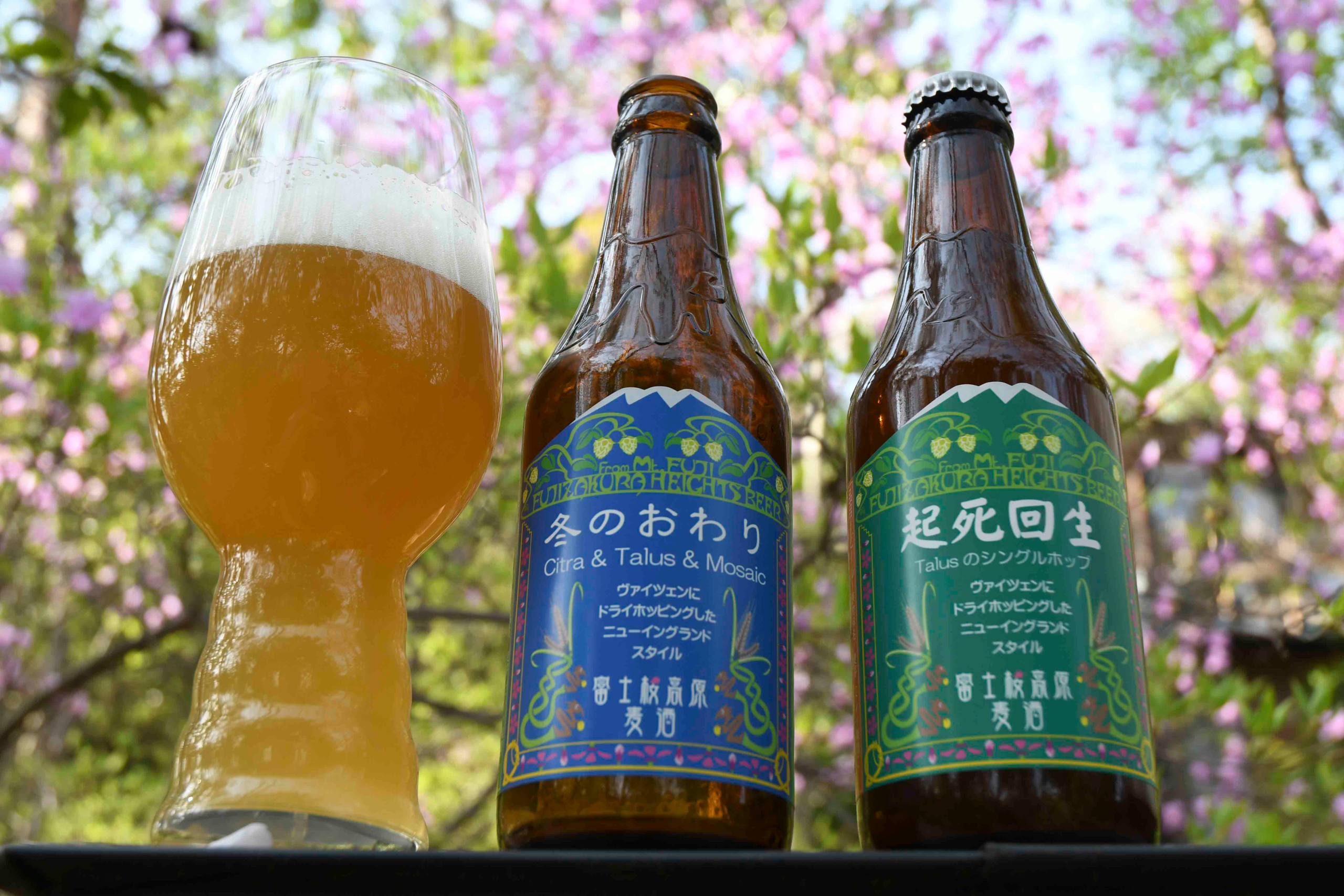
There have been a string of NE Weizens released by Fujizakura over the past couple years, featuring various hops and combinations thereof. The two latest have both featured the new American hop, Talus. Fuyu no Owari (Winter’s End) featured Talus with two other classic NE IPA hops, Citra and Mosaic. It had a complex hop character, with citrus notes complemented by tropical fruit and herbal, resinous flavors. Kishi Kaisei (Resurrection) was hopped only with Talus, and here the single varietal shines. It is very tropical, with coconut and pineapple, along with melon and banana notes from the yeast. Past single hopped versions include El Dorado (El Dorado), Fukyu Fukutsu (Zappa), Hop Jewelry (Idaho 7), and Ungai Souten (Ekuanot). It’s most interesting to try several side by side.
Hideki Iwata at Daisen G Beer has brewed a NE Weizen, Another Weizen (7.5%), using a similar technique. This was also fantastic, which is to be expected if you are familiar with any of Daisen’s other wheat beers. It had a full-on weizenbock malt and yeast character, with lots of tropical and citrusy hops. Minoh Beer regularly releases its seasonal Hoppy Weizen (5%), which is rare in being so “low” in alcohol. While not as well known as Minoh’s wildly popular Momo Weizen, it is every bit as good, with citrus fruit and funky, over-ripe mango notes from the hops that go very well with the rich clove flavors from the yeast.
From Florida-style fruited Berliner Weisse to Hopfenweisse to White IPAs to NE Weizen and Wheat Wine, it is fun to see wheat playing a much more expanded role in craft brewing. Some of these innovations have their detractors. I have heard from several beer lovers that they simply do not like the interplay between dry hopping and weizen yeast phenols. I see their point, and personally also feel that some hops work better in these beers than others. It is definitely a fun new hybrid. When you get tired of IPAs, but are not quite ready for a weizen, grab a hoppy wheat ale, whatever it calls itself, especially now that warmer weather is upon us.