



By Momoyo Kagitani, Brewmaster at LocoBeer in Sakura, Chiba.
Kölsch is one of my favorite beer styles. Its birthplace is historic Cologne, Germany, a city along the Rhine River dotted with remnants of ancient structures from the days when the Roman Empire’s reach encompassed the area.
Kölsch ranges from straw-colored to golden in hue. It must be completely absent of chill haze. Ideally, it should have a somewhat frothy head with substantial head retention. There should be little to no fruity esters. If present, there will be hints of pear, apple or Riesling, accompanied by a wine-like character. Noble hops provide subtle aroma and taste, with a moderate bitterness. There should be only a slight caramel character perceived deriving from the roasted malt used. Kölsch should be somewhat dry accompanied by a slight sweetness. It should be refreshing with a light mouthfeel. To enhance this and also provide a full head, it’s acceptable to mix up to 20% wheat malt into the mash. Kölsch employs top-fermenting yeast, but it is fermented at lower temperatures than is the norm for such yeast in countries like England and Belgium, where ale yeasts have a long history. Maturation is also undertaken at low temperatures, as well. Primary fermentation is done with ale yeast but lager yeast may be added for bottle conditioning or the final cold conditioning. Diacetyl shouldn’t be present. Body should range from light to medium light.
I made my first trip to Cologne in 2004. One of my plans for the trip was to have my wedding ceremony in Germany, but due to some strict and confusing legalities, I couldn’t hold it there. Instead we ended up first having the ceremony in Spain and changed the trip to Germany into our honeymoon. I haven’t been back since, but I would really love to visit again. During our visit we planted olive trees in both countries as a marriage memorial–plus, I also love olives. So my next visit will be a combination of checking on my trees and, of course, beer “research”.
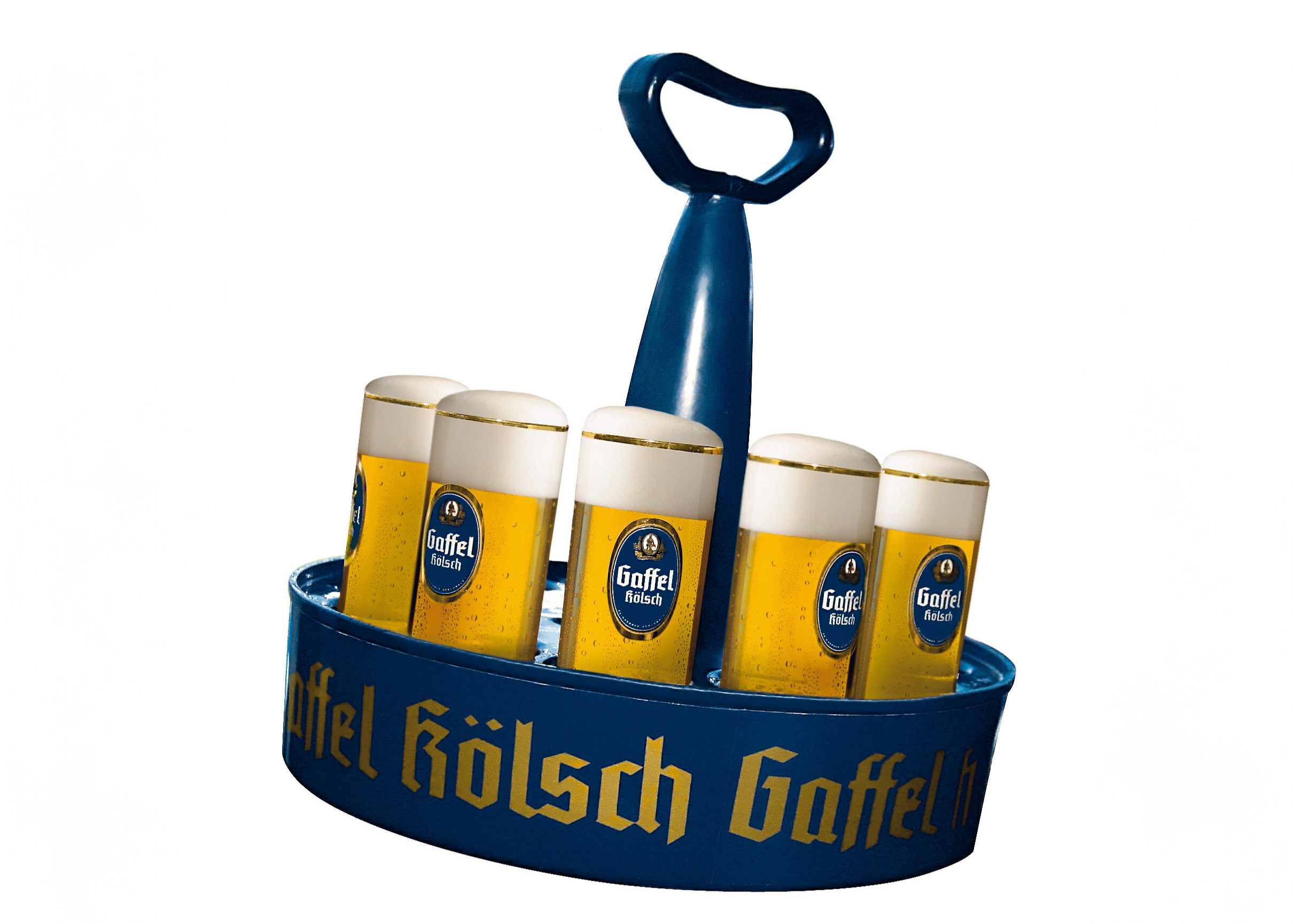
As you might imagine, while I was in Cologne I consumed a whole lot of Kölsch. From variations in bitterness, sweetness, and hop flavor, I discovered that the style was wide ranging, to the extent that I felt they were completely different beers. Among these, the one that left the most lasting impression was Früh. It’s not an exaggeration to say that it’s beautiful light color was nearly transparent. It had a silky, frothy head and despite its dry taste that made drinking it down like water possible, it had refreshing character accompanied by a tinge of sweetness and a soft mouthfeel. I recall being completely blown away and thinking, “What a fantastic beer!” Looking around me, I noticed everyone with stange (narrow 200ml glassware traditionally used for Kölsch) in hand, drinking them dry at a fast pace. There was no waiting for a refill as staff darted about with circular kranz trays full of beers to replace those that would soon go empty. I was impressed by the entire scene. Gaffel’s Kölsch was another that left a strong impression on me. On drinking it, I wondered if it was even a Kölsch; I was caught off guard by its bitterness and full body.
Some of my favorites from Japanese breweries include those made by Tazawako (Akita) and Onuma (Hokkaido). Tazawako’s version has a fuller body and is a little darker in color than normal. It’s also moderately bitter. Conversely, Onuma’s Kölsch is on the lighter side of the color range for the style as well as relatively low in bitterness. The beer has earned numerous awards in the category in both domestic and international competitions. It’s a beautiful, refreshing beer, in my opinion.
Kölsch has been the flagship brew (called Sakura Kaori no Nama) at LocoBeer since 2000. Drinking a variety of authentic Kölsch at its true origin in Cologne, I remember feeling pleasantly surprised that my personal version was nothing like any of those. In particular, I noted with certainty, the strongpoint of our Kölsch is its aroma.
Additionally, every year since 2017, I have been making Ibuki no Nama, a single-hop wiess (unfiltered Kölsch) using a copious amount of freshly harvested, domestic Ibuki hops. For both of the Kölsch I brew, the wort is exactly the same. The only differences are that the wiess emphasizes the hops and is not filtered. The end result, however, is two beers that really taste nothing alike. To this day I can vividly recall my shock when comparing the tastes after finishing the first batch of the wiess.
When I was in Cologne, the fact that Kölsch had such a wide range became obvious to me. Just minor changes to the base ingredients can cause dramatic differences in taste. This charming appeal of the style has really pulled me in. As someone who was originally not into beer so much, Kölsch was the catalyst for me to seriously enjoy beer. I encourage all beer fans to try styles that have as broad a spectrum as this. Thanks to my introduction to Kölsch, I myself have found the motivation to continue trying my hand at brewing a wide variety of beers in the years to come.