



I wrote a beer styles article about saisons for the Spring, 2013 edition of JBT, when saisons basically meant Saison Dupont or any beers that mimicked it. It was when only a handful of brewers in Japan even attempted the style. Things have certainly changed in the past eight years. Led by experimental brewers in the US, the very concept of what makes a saison has expanded far beyond its Wallonian farmhouse roots and come to embrace a wide range of grains, hops, yeasts, additives, and methods, making the style so diverse that we may actually have to ask what it is that these beers still share in common. But that’s a question for another day.
Saisons are derived from ales that were brewed on farms over the winter months, for consumption during the hotter times of the year, particularly during the harvest. They typically used grains, hops, and spices that were available on the farm, which often meant recipes that contained more than the four ingredients of a lager. They would have been fermented by ambient yeast and bacteria, which is the basis for the complex, multi-strain yeasts that are used in most saisons today, as well as the mixed fermentation saisons that have become so popular over the past decade. As much of the experimentation with the style among craft brewers has been done in an attempt to replicate old farmhouse conditions in the modern brewhouse, they include the use of alternative local grains in addition to malted barley; wooden barrels for aging; locally sourced hops, fruits, herbs and spices; and mixed fermentations that employ brettanomyces yeast, lactobacillus bacteria, or other funky creatures to make for a more complex end product. Other brewers have focused on getting the perfect degree of bottle conditioning, to make their saisons more consistent with the tradition of brewery saisons in Belgium. Still others have aimed for low-alcohol versions, like those that the farmhands of yesteryear probably consumed.
The 2013 article mentioned just two Japanese saisons: Baird Saison Sayuri and Shiga Kogen Yamabushi. These are both still made, with the recipe for Sayuri changing slightly every year and the Yamabushi line having expanded to dozens of iterations, using various fruits, spices, and barrels to age in. Do try these, and as many of the new Yamabushi variants as you can find.
There are now literally hundreds of breweries in Japan that brew some sort of saison. Shiga Kogen continues to be a pace-setter in the style, having released over fifty different saisons since our last article. They have been joined by many newer brewers with a dedication to the style, and several older breweries have dived head-first into saison brewing as well.
The rest of this article will focus on recent innovation in Japanese saisons and farmhouse ales. Rather than simply listing dozens of the great saisons that are made here, we will introduce a handful of unique, innovative, and excellent saisons. Invariably there will be some wonderful beers that we miss here. We apologize for that beforehand—hopefully we can revisit those beers before the next eight years pass.
Nara Brewing Company Integral: Mastering the Art of Bottle Conditioning
Bottle Conditioning: this process may not seem particularly innovative in regard to saisons, since most Belgian saisons have been bottle conditioned as long as there were Belgian saisons. The process is still relatively new to Japan, however, and Nara Brewing in particular has revealed just how big a difference bottle conditioning can make in the effort to reproduce an authentic Wallonian-style saison. After releasing a number of saisons in kegs, in early 2020 Nara released two versions of Fleming in 750ml bottles. Both were bottle-conditioned, and one contained brettanomyces as well as saison yeast. These were replaced by Integral later in the year, which also has come in regular and Brett versions. At 7.5% ABV, Integral is not quite a “super saison” but pushes the limit of strength for a regular one. It hits all the right buttons in terms of spicy farmhouse yeast character, honey-and-bread malts, and crisp, brilliant Styrian
Goldings hops. What is truly amazing, however, is the body. It pours out with great effervescence, and an enormous, fluffy head of foam. It is crisp, snappy, and the closest thing to a standard “brewery” saison from Belgium that I’ve found in Japan.
The Brett version takes this all a step further, with more fruit, especially stone fruits, citrus, and apple, and a hay-like barnyard character. It has a dry, champagne-like finish. My advice with this one is to age it for a year or more before opening it, as the brett character definitely develops with time.
Kyoto Brewing Company Rebel with a Cause: Radicalizing the Table Saison
Kyoto brewing co. has released at least thirty-seven different saisons since they started brewing in 2015. Ichigo Ichie is one that is produced year-round, and through 2020 the Shunkashuto (Spring-Summer-Autumn-Winter) series gave us a new saison every time the season changed. They discontinued this series in 2021, wishing instead to branch out into new farmhouse-style directions. One result was the ultra-low alcohol Wakage no Itari (Rebel with a Cause). KBC has produced table saisons in the past, including Little Pleasures at 4% and Farmer’s Table at 3.5%, but Rebel uses alternative brewing methods to clock in at a mere 1% ABV!
Unlike “beer taste drinks” or low-alcohol beers produced by the industrial giants, which are either not fermented at all, or sometimes just watered down, for Rebel, a cold mash is used, which results in much less of the starch in the grain being converted to sugar, and thus much less sugar converted to alcohol. Yet since there is no shortage of malt being used, the resulting malt character and body, while certainly differing from a 5% saison, are much more prominent than in most low-ABV beers. Dry hopping with Simcoe, Aramis, and Cascade, coupled with the spicy character of the saison yeast makes for the perfect beer to reach for when you want to enjoy a proper beer but do not want to be impaired by alcohol.
KBC also released its first bottle-conditioned saison this year, Kodo wo Yuku, or Pilgrim’s Respite, in 750 and 375 ml bottles that we hope to see more of.
Yorocco Barrel Aging Project: Mixed Fermentation, Local Additives, and Wood
Along with producing Peninsula Saison the whole year round, Yorocco brewing has produced a staggering variety of farmhouse ales, many of them collaborations with nearby farms, using their fruit, vegetables, and herbs. 2021 releases include one saison with chamomile and another with ume that were part of the “From the Local’s Backyard” series. Others include Flor de Jamaica, with hibiscus and Plum bon, a collaboration with Minoh Brewing that uses sumomo plums. Using such local ingredients is certainly a link to saisons of the past, but so is the use of wooden barrels for aging and brettanomyces fermentation that take place in the Y/B/A/P beers, the majority of which have been saisons.
2021 saw the release of Dry Hopped Brett Saison, aged in a red wine barrel from Yamanashi for eleven months; Kinkan Brett Saison, using locally-sourced kumquats and aged in French red wine barrels for fifteen months; and a new edition of Barrel Blended Saison, aged in three French wine barrels, each employing a different strain of brettanomyces yeast. The barrel influence was quite bold in Blended Saison, with lots of red wine and oak tannins to go with a barnyard brett character that was quite bold but still seemed like it would increase with more time in the bottle. Kinkan Brett was a wonderful balance of red wine, oak, barnyard, and bright kumquat. I don’t see it getting better with time, as that fruit character would likely fade. Releases in the Y/B/A/P are definitely limited in amount and you’ll have to be quick to get hold of them, but they are worth looking out for.
2nd Story Ale Works Farmhouse 2021: Mixed Fermentation, Dry-Hopped, Multi-Grain Farmhouse Ale
2nd Story started brewing in 2018 in an old farm building in Tokushima. Their most visible beers are IPAs, but they have produced a healthy number of saisons as well, including those in the Saint Yoshie line, which includes one with ume and another with cardamon. Farmhouse 2021, like its predecessors Americana and Japonica from 2019, takes this to another level. Brewed with genmai (Japanese brown rice) and rye as well as malted barley, and with added black pepper, Farmhouse 2021 is fermented with two strains of saison yeast plus brettanomyces. It fermented for four months in the tank, after which it was dry-hopped with Hallertau Blanc and Mosaic, and then bottled or kegged. This then matured for another four months before its September, 2021 release.
Eight months in, the effect of the brett yeast was certainly noticeable, though it was also clear that it would continue eating away at the remaining maltose for months to come. The hop character was still big and bold, with luscious fruit aromas, including stone fruits, citrus, and tropical fruits. To really understand the workings of the brett, this should be sampled alongside one of the 2019 Farmhouse beers, a few bottles of which are still available. In those, the hops and sugar are nearly gone, and the funky barnyard character is far more prominent.
Also, you might keep your eyes peeled for a brett-and-lactobacillus-fermented sour farmhouse ale on peaches, scheduled to drop in late 2021.
Anglo-Japanese Brewing Rhubarb Sunrise: Rhubarb Saison, Two Years in the Foeder!
Rhubarb is definitely not your typical beer ingredient. Barely known in Japan, it’s normally thought of as the other vegetable that ends up in sweet pies in the West (along with pumpkin, of course). Cantillon released Nath, their rhubarb lambic, for the first time in 2008, and AJB released their Rhubarb Saison for the first time back in 2015. The Rhubarb added tart, citrusy, and fruity notes. Rhubarb Sunrise starts with a saison fermented in steel which is then transferred to a 40-barrel oak foeder, where brettanomyces is also added. This matures in the foeder for two years. It is then blended with 50g/l of locally-grown rhubarb.
The result is a super complex farmhouse style saison with typical “horse blanket” and old leather notes that come from a long brett fermentation. Tannins from the oak are well balanced by the fruity rhubarb. We’re looking forward to more blends coming from these foeders.
Zakkoku Kobo NaRa Ripened Saison: Brewed with Homegrown Grains and Aged in Foeders
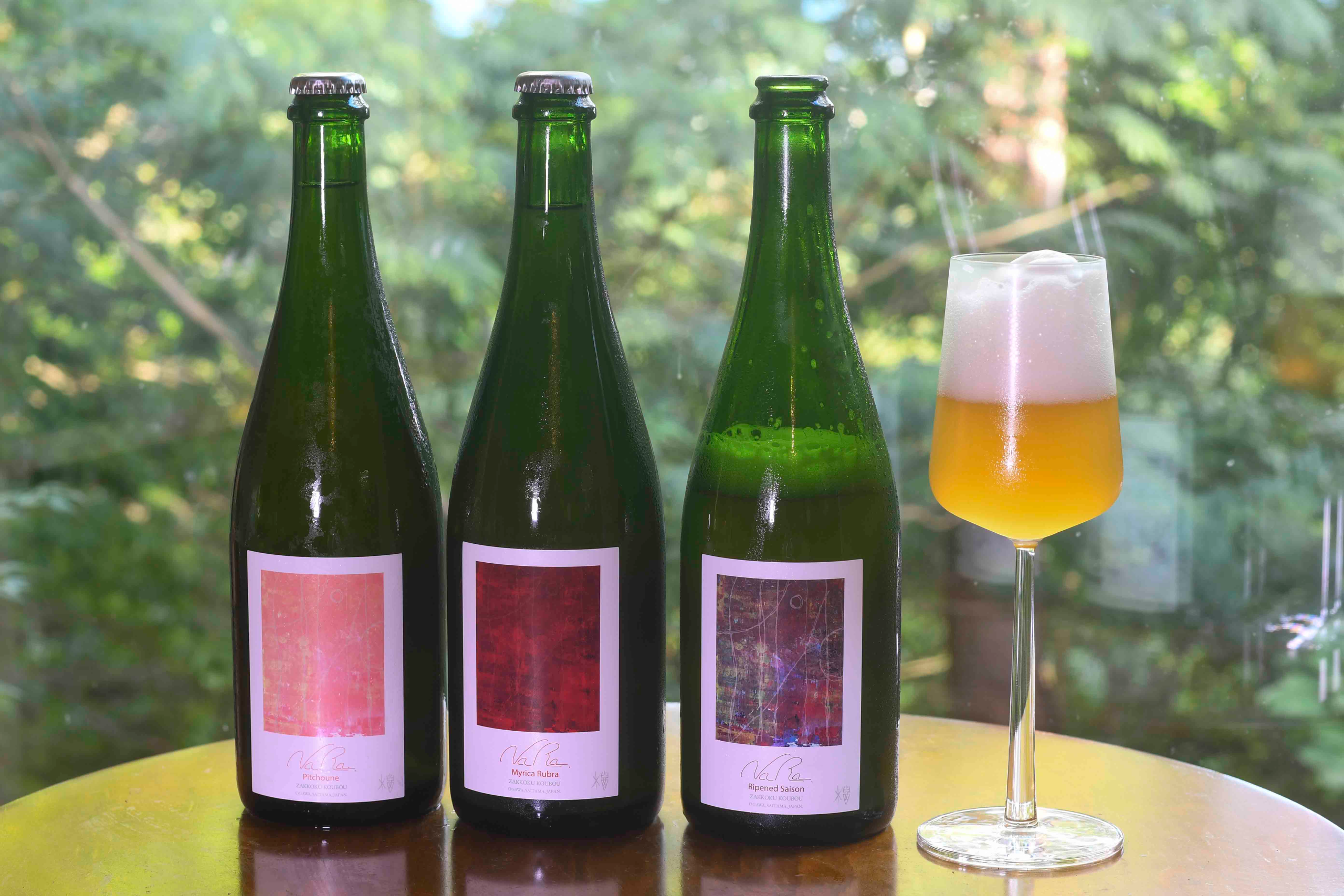
Zakkoku Kobo in Saitama is a brewery that has always been connected to a farm. Their Zakoku Weizen has from the beginning included home-grown rye and wheat. Zakkoku first produced their Rustic Saison, containing home-grown rye, in 2014. Since then, they began malting their own barley as well, so now the mash bill contains 17.8% house malt and 10.7% homegrown rye. Rustic Saison is hopped with Centennial and fermented with a combination of French and Belgian saison yeast. Irodori is a series of flavored saisons using homegrown and local ingredients, usually with a simpler base beer than Rustic and slightly lower ABV. The latest in the series, No. 11, features mint, while earlier versions have featured homegrown yuzu, pickled green lemons, mandarin oranges, sansho, and ume. Irodori has also been brewed with 100% house malted barley. Rustic Saison is the base beer for the NaRa Series of foeder-aged saisons, which appeared for the first time last year. The beer ages in American oak for two months, picking up tannins from the wood as well as a lactic fermentation due to the lactobacillus living in the oak. Ripened Saison is the unflavored version. It is massively fruity, with lots of lemon, orange, and stone fruit notes. Underlying that is a lactic acid creamy tartness and barnyard notes, and it is tied together by a tannic oakiness.
This year also saw the release of three flavored versions of NaRa: first was Myrica Rubra, which is the scientific name for the Japanese bayberry, or “yamamomo”. For this beer, 85kg of bayberry, all grown either at the Zakkoku farm or at a neighbor’s, were added to the fermenter with the fresh saison, and all underwent the two-month maturation. NaRa: Pitchoune replaces the bayberry with 120kg of Fukushima-grown white peaches, while NaRa: Harvested Hop & Sansho uses, as expected, homegrown hops and sansho both homegrown and from other Ogawa-machi farms. NaRa: Pitchoune Deux was made by blending Rustic Saison and Dark Fruits Saison in the foeder still holding the peaches from the first batch, and letting that mature for four months.
Although it is not yet possible for them to brew all saisons using 100% of their house malt, in using so many homegrown and local ingredients—grains, hops, and fruits—as well as ambient wood fermentation, Zakkoku Kobo’s saisons are true farmhouse ales in what is almost the strictest sense of the word. And they are truly delightful beers as well.
This is not, of course, the last word on Japanese farmhouse ales / saisons. Shiki Brewery in Saitama has produced many 750ml bottle-conditioned saisons that have been excellent. For You and Me Beer from Yo-Ho is widely available in convenient stores across the land, and Japanese Saison from Hitachino Nest is almost as easy to find. Excellent saisons are regularly brewed by Y Market, Vertere, Daisen G, Far Yeast, and Yggdrasil, to name just a few, and Songbird Brewery also makes many farmhouse-inspired beers without calling them saisons. These are all worth a try, but the focus of this article has been on some of the more innovative and unique saisons that have been available in 2021. After all the attention given to hazy IPAs and fruit sours lately, it’s good to see such a great amount of growth in the saison style. With more and more brewers sourcing local ingredients, and others obtaining foeders and used oak casks or experimenting with mixed fermentation, this is surely a style that will continue to expand in Japan.