



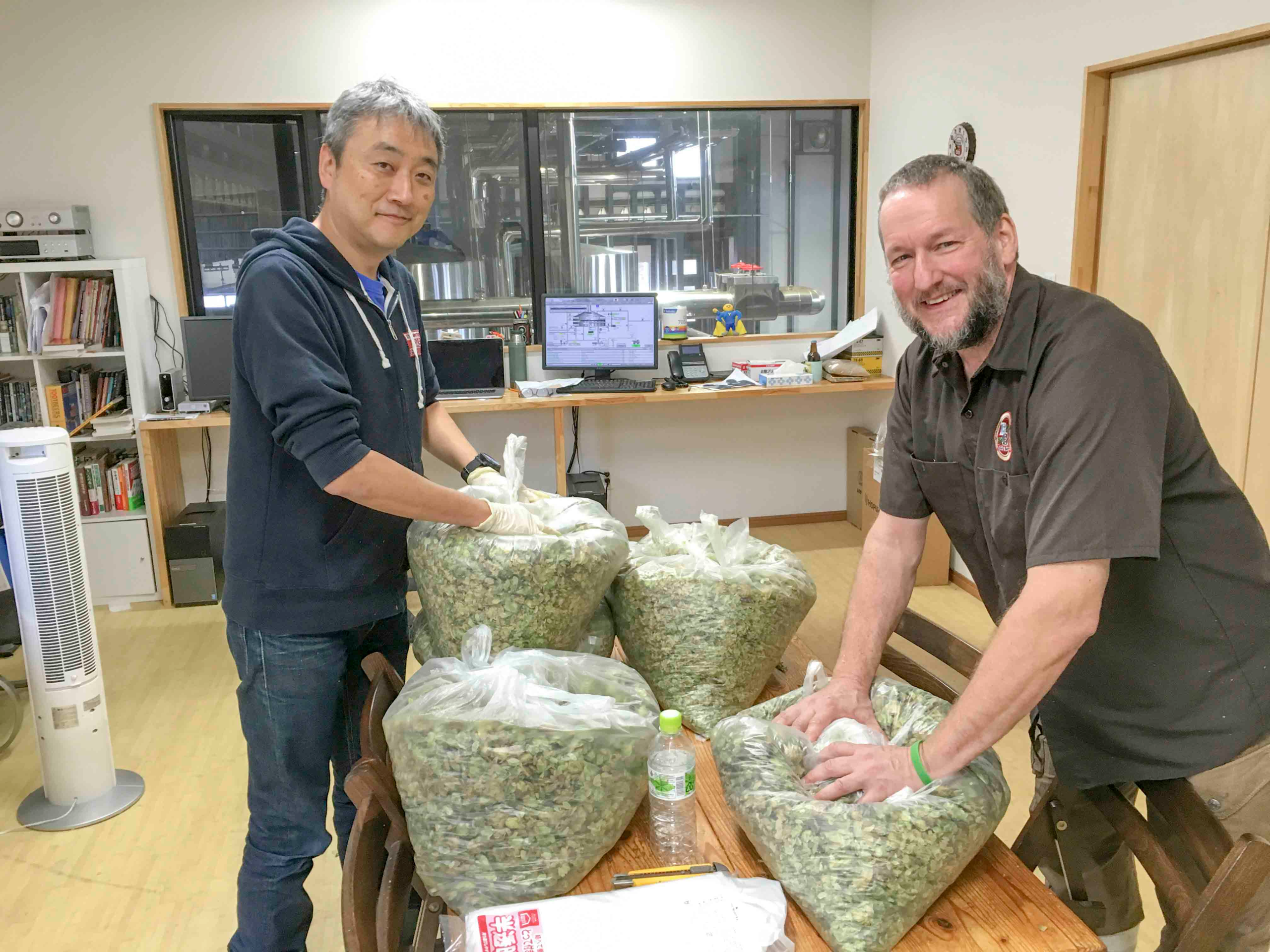
By Chris Poel who is the Chief Brew Officer at Shiokaze BrewLab, Chiba City.
Anyone who has known me for longer than a minute knows that I love hops. There’s nothing better than nice hoppy aroma and clean bitterness. I’ve never met a hop I didn’t like. Well, there are a couple that I don’t much care for, like Sorachi Ace or Cluster, but overall hops are the gods’ gift to mankind. Given my affinity for hops, you might naturally guess that my favorite beer style is IPA in all its many wonderful iterations.
Well that’s not the case. For sure, I do like drinking IPAs, make no mistake about it. But to me, the perfect beer to show off the pure joy that hops impart is the American pale ale. Those made with classic American citrus and floral hops, especially, are a thing of beauty.
A classic American pale ale presents a simple malt backdrop, mostly pale malt with perhaps a small amount of Vienna or Munich, and a touch of specialty malt. It should be neither sweet nor too dry. This beer is all about balance. I prefer brewing with English or German pale malts, which give a bready or biscuity presence that can be lacking in other two-row pale malts. A perfect pale ale comes in at 5.0–5.5% ABV. At that strength, you can put in a long night of drinking with friends, colleagues, and even strangers without waking up the following morning with regrets.
But it’s the hops in a classic American pale ale that really get me going. Citrus, floral, and oh so good. The classics are perfect–a blend of Cascade, Centennial, Columbus, and Chinook, maybe with some Amarillo or Simcoe for complexity–and you’re on your way to a beautiful pale ale. Modern tropical hops have no business here; save them for your new-fangled session IPAs or hazies. (I could go off on a long rant here about session IPAs being nothing more than pale ales with fashionable new hops, or how hazy IPAs are not IPAs at all, but that would just serve to raise my blood pressure and not be very constructive.)
For bitterness, 35 IBUs is a good target, with first wort and/or bittering additions and plenty of late hops, whirlpool hops, and dry hops. Adding the hops at different times in the boil contributes to a complexity, a kind of layering effect, that doesn’t show up in a lot of modern pale ales. With all those hops flying around, it can be easy to veer into IPA territory. It takes a subtle hand to know when it’s enough to avoid over-hopping.
A big part of my love affair with pale ales can be credited to Sierra Nevada, the first really good craft beer I ever drank, and still one of my favorites. To me, the balance of this beer is near perfection. Whenever I go to a new brewery, I seek out their pale ale. If they make a good one, I try their other beers. If the pale ale is not up to my standards, then I move on to the next place.
Classic American pale ales can be hard to find, as more and more breweries have rebranded them as session IPAs. However, Baird Brewing’s Rising Sun Pale Ale, with its great blend of US citrus hops, always pleases. Brimmer Brewing also makes a wonderful American pale ale that’s worth seeking out. And while it’s not as easy to find, Shiga Kogen’s “Africa Pale Ale” is always enjoyable. Add to that list TDM’s pale ale and you have a great tasting session in the works.
Imports that I enjoy when I can, include Stone Brewing’s wonderful pale ale and Founders All Day (even though All Day is called a session IPA, make no mistake, it’s a pale at heart). And I’d be remiss if I didn’t mention Dale’s Pale Ale, the first of its kind to be released in cans.
When I started Shiokaze BrewLab, I vowed that we would always have a classic pale ale as part of our regular lineup. Shiokaze’s pale ale offering is Cascade Yazamani, which boasts an ABV of 5.5% and 32 IBUs of hop bitterness. While the name makes it sound like a single-hop ale, we actually bitter with Centennial and then use a blend of Cascade hops sourced from five different regions: France, Germany, New Zealand, Michigan, and Yakima. The result is an intriguing hop complexity that satisfies.
In support of that hop blend, we use around 87% IREKS Pale Malt, 10% IREKS Vienna Malt, and a touch of light crystal and acidulated malts. Finally, we ferment our baby with Lallemand Koln Kölsch yeast at 18C. The yeast contributes a nice fruitiness that plays well with the hops and malt.
Classic American pale ale–it’s a great beer on a hot day, a cool day, a cold wintery day, pretty much any day. If it’s been a while since you’ve had one, do yourself a favor and grab one soon. You won’t be disappointed!