



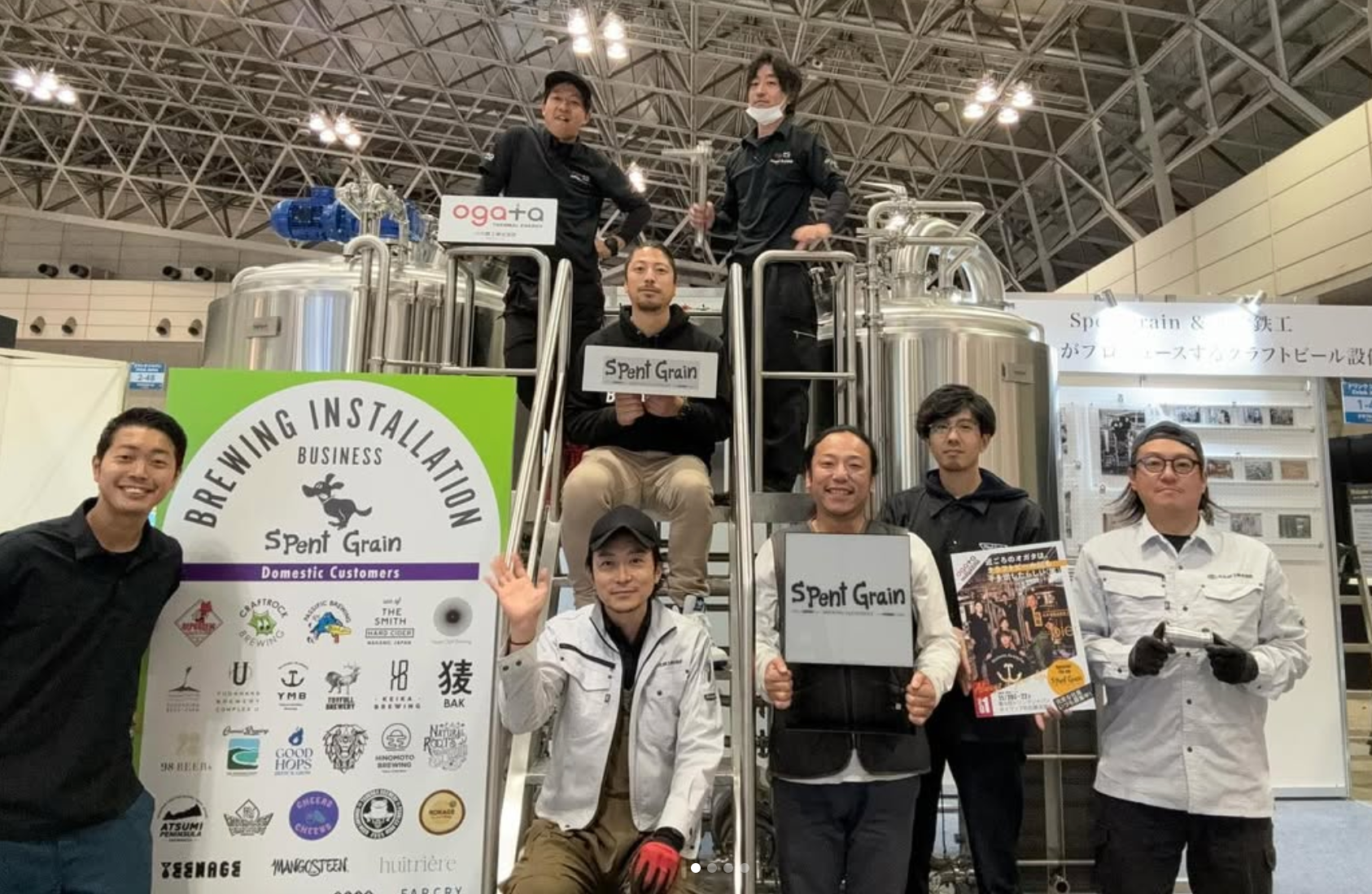
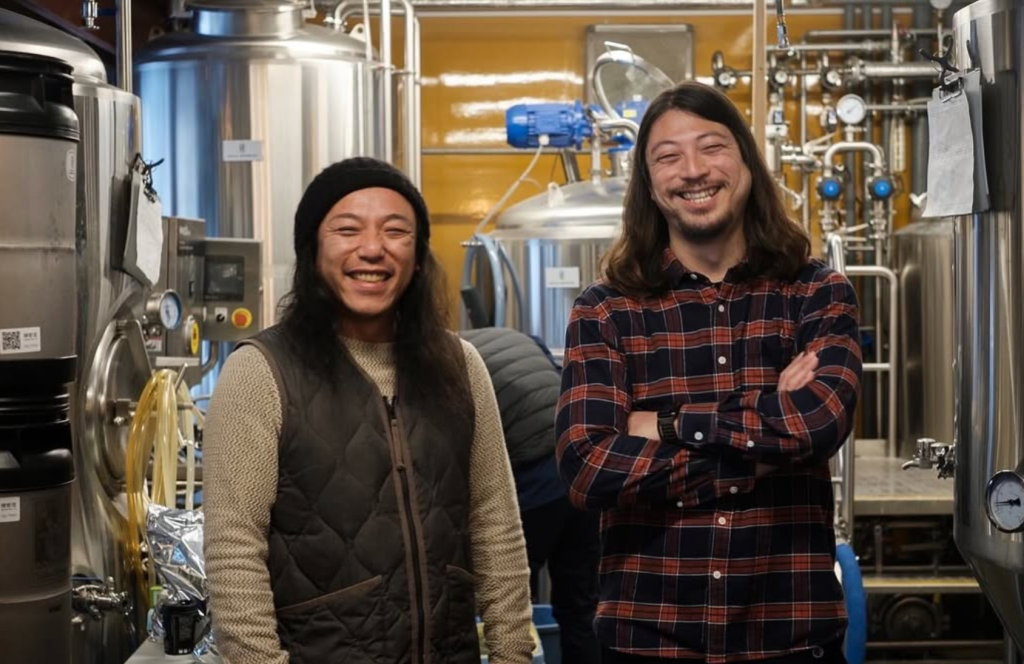
Over the last few years, the number of breweries in Japan has more than doubled to over a thousand. Of course, breweries are not do-it-yourself kits; they require professionals to set them up. Additionally, ambitious companies are diving into the industry without sufficiently experienced staff, either. Spent Grain has been a key player in providing support for both of these needs. Headed by veteran brewers Ryo Suzuki and Takahiro Nagaishi, the company provides a range of services covering all needs: the design and paperwork for new breweries, the importing and installation of brewery equipment (including entire breweries), brewing training on those systems, and more. We recently sat down with Suzuki and Nagaishi to hear the story and where they’re heading.
When was Spent Grain started and why?
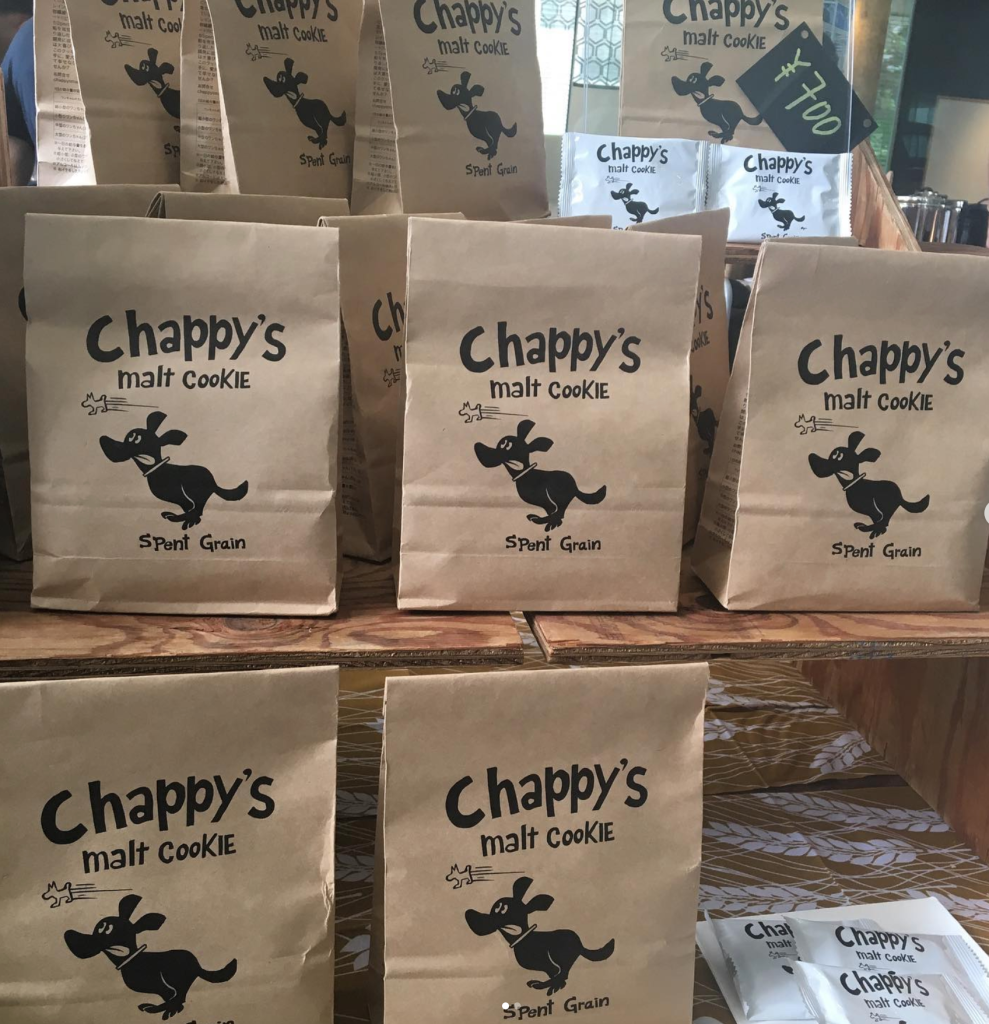
Nagaishi: We started making malt cookies from spent grain in 2016. We sold them for dogs, but actually, they were originally intended for humans. Public health authorities were not exactly thrilled by the idea. We couldn’t get permission from any of them. The malt cookies were made from spent grain and they said that because the cookies contained something that was at one time a waste product, it was a no-go. We then started installing tap systems—something we still do today—and from that we slowly transitioned into importing, selling, and doing maintenance for brewing equipment.
Why did that particular business appeal to you?
Nagaishi: As far as brewery equipment goes, well, we’re brewers and thus the ones who know the equipment best because we use it all the time. Brewers say things like, ‘I wish there was this feature here’ or ‘I want to do a decoction mash’ and we simply modify the machinery to fulfill those requests. If you know how to do it, you can. So basically we dove into the brewery equipment business because of our background.
Where do you source most of your brewery equipment?
Nagaishi: In Ningbo, China, there’s a company called Tunwell whose equipment we now import and sell. Around the time we started out, there was a lot of poorly made stainless steel equipment coming from China and so we weren’t sourcing everything from China–though some people did. We basically thought to step in as intermediaries.
And from helping ensure clients get quality equipment from China and even setting up their breweries for them, you then moved into helping them with brewing and other consulting?
Nagaishi: Yes, that’s correct. We installed the equipment and, sure, there were places where there were already experienced breweries, but when there wasn’t, we’d go in and provide that kind of support.
So you’d train folks for several months?
Nagishi: Yes, we had a contract period.
Did you ever turn down clients because, for example, they just had no brewing experience whatsoever? For example, they suddenly wanted to launch a brewery and then called you?
Suzuki: There are a lot of those places, actually.
Like hotels and entities looking to supplement their main business with a brewery?
Nagaishi: Yes, like that. You know, craft beer is booming so there are many businesses that say, ‘We want to give it a try. Could you provide some guidance?’ Or ‘We’d like to brew here,’ but in those cases we have to look into legal aspects for them, too. For example, is it even okay to brew where they’re located. So with things like that, we actually visit the client to check things out.
And so you help with getting the brewing license as well?
Nagaishi: Yes, we help with the application.
You’re providing support for quite a period of time, then, aren’t you? From the time you meet your client until the brewery is up and running, it could take a year or two of providing all kinds of help…
Nagaishi: That’s correct. For those that need it, we provide that support.
Have you had any interesting clients? Back thirty years ago when craft beer was getting started in Japan, there were many hotels launching breweries. Wedding halls, too. Anything along those lines? Like a golf course brewery?
Nagaishi: Actually, we are currently working on some interesting projects but can’t say anything yet. During COVID, there was all kinds of crazy grant money being thrown around. There was this “Business Restructuring Subsidy” where two-thirds of your estimated costs would be covered—paid out of taxpayer money. And so all these breweries were getting launched at the time. Around 2016, we went from maybe 300 breweries to around 400, but now there are roughly a thousand. So during that surge, there were some interesting breweries being launched–and, like you said, wedding halls that wanted to make their own beer for weddings.
Suzuki: And then there were hot spring resorts–breweries attached to the lodgings. There have been just so many different companies…
It seems like you are doing a lot of travel for this work.
Suzuki: To the various resort companies, that’s certainly the case. We had a pachinko client, too.
A pachinko brewery?! That’s dangerous (laughter)
Suzuki: But that’s who was doing it!
Obviously, you must hope that everyone does well, but how well do these businesses actually do?
Suzuki: Among our clients, there are two patterns really. There are established businesses that come to us, or who receive an introduction from somebody and come to us. And then there are friends or friends of industry colleagues that are going independent, trust us, and ask for our assistance—there are quite a few of them. Among those, some well-known ones we’ve helped build include Passific and Open Air.
Nagaishi: Also Teenage Brewing.
And so places like that already had experienced brewers that had worked elsewhere?
Suzuki: Yes, Open Air’s brewer came from Nom Craft. With Passific, you had Shiga Kogen and Craft Rock. Most of those folks had a lot of experience already.
And do you go back on occasion to help with recipes?
Suzuki: With those (experienced) folks, no, not really. They have plenty of things they want to do on their own. But on the other hand, you have those other businesses. They might say, ‘We just want to start brewing now,’ but they don’t yet have a concept of what kind of beer they want to make. So in those cases, we have to help them along.
So if we wanted to build a brewery inside our office here in Noge, Yokohama, you’d help us?
Nagaishi: (Laughter). Yeah, let’s do it!
What’s the typical size of breweries you build?
Nagaishi: Mostly small ones. The smallest we can do is two-barrel. But our strength is with ten-barrel. We’ve put in a system as large as twenty-barrels before.
How are you building all of this?
Nagaishi: We have other companies we partner with. Electrical work—that obviously needs an electrician.
As for brewery launches, you must see all kinds of people, including women, resident foreigners…
Nagaishi: Yes. Women, absolutely. There are women brewers at Karuizawa Q, and at Teenage.
Suzuki: Yamamotoyama Kogen Brewery in Niigata.
Nagaishi: Yeah, they’re making pretty good beer, too.
Among the places you’ve been helping, have you ever gotten any emergency calls? Like they’ve got a stuck yeast or something like that?
Nagaishi: Almost every day, we get some kind of call. If it’s a brewer that has some experience, it’s easy to work things out, but with brewers who aren’t as experienced, they have a lot of simple questions: What is a compressor? Should I open the butterfly valve? The questions start from very basic things.
Isn’t there some danger in that?
Nagaishi: There is. And so there are some places where we have to teach things like basic brewery hygiene and provide classroom-style lectures.
In a way, you’ve become a kind of brewing school, not like Nōdai, but the kind of place that anybody can go to. Maybe you should open a proper school! There are quite a few vacant school buildings out there. Call it Spent Grain Brewery School.
Nagaishi: That would be interesting. But again, the problem in Japan is that there are not enough brewers. Sure, there are plenty of people that want to do it, but wanting to do something and being able to do something are two different things so it’s a difficult situation. You need know-how and industry connections, too.
At present, how many clients have you served?
Nagaishi: Seventy. That includes places where we’ve installed a brewery or other machinery like a canning line.
Wow. You’ve been busy. Maybe too busy. I mean, Suzuki has a separate job as a brewer. Do you have time to brew?
Suzuki: Absolutely. I’m doing just fine with it!
Nagaishi: (laughter) But I worry about you.
Suzuki: Several years ago, around 2021 or 2022, right when the pandemic was winding down, there was—as we mentioned—a kind of boom of support funds from the government. At that time, we were definitely struggling to take on all the work. If was like there was hardly any time to sleep, and we were working every day.
Is there anything at present that you’d like to do?
Nagaishi: I’d like to build our own brewery—our own Spent Grain brewery. It would act as a kind of showroom.
I take it that you, Nagaishi, would run the brewery?
Nagaishi: Yes, but we have another employee at Spent Grain who is a brewer.
And if you were to realize this dream, what location were you thinking?
Nagaishi: We’re looking in Odawara. Yokohama would be great, too, but there’s a lot of competition.
Yokohama is a big city, though; it doesn’t feel as if there are that many breweries. Most are brewpubs. Then again, rent is expensive…
Nagaishi: Everywhere in Yokohama is pricey. Even off the beaten track we’ve seen rent prices above ¥700,000 a month. But if you’re too far off the beaten track, nobody will come.
So Odawara it is!
Nagaishi: We’re looking, but haven’t found a spot…
Anything else you’d like to achieve beyond that?
Nagaishi: We’d like to do a Spent Grain festival. Like we noted earlier, we’ve helped 70 clients.
Suzuki: The reason we’re engaged in this kind of work is that for us it’s fun to do and that’s the main driver, but that’s not all. As we hinted at earlier, there’s been frustration in our industry: not having good equipment, buying equipment and finding out it’s not what you expected, running into constant problems. Since we install all the systems for you, we can eliminate those issues. There are about 1000 breweries nationwide now. To speak truthfully, only about 20% are currently making great beer. So the question is, how can those remaining 800 breweries improve? Or, for that matter, as new breweries pop up, how can they at least produce beer to a minimum standard? As we also discussed earlier the ideal solution would be the creation of a proper school. But since we are brewing beer ourselves while doing all this, all that we can do right now is a kind of start-up-style approach. We source good equipment, we carefully plan the layout, improve the workflow, and create a proper work environment for the brewery staff. And at the same time, we offer training. Through that kind of total support, I think we can help breweries reach a level where they’re making good beer. By supporting them in this way, I hope we can increase the number of Japanese craft breweries that are producing truly delicious beer
Thank you, that sounds like a good goal!
Spent Grain: https://spentgrain.co.jp/
