



by Lars Marius Garshol
Saisons used to stand out as this odd style of beer that wasn’t actually made in a brewery, but was instead made by farmers for enjoyment on the farm. Over the last few years it has started to sink in that saisons are just the tip of the iceberg. People realized, for example, that Finnish sahti and Swedish gotlandsdricke are also farmhouse ales.
Which is odd. How much does the Finnish countryside, a Swedish island in the Baltic, and western Belgium have in common? Not much beyond farmhouse brewing turns out to be the answer. This style of brewing was actually far less unusual than people believe. To see the big picture we must go back a bit. The world not long ago was very different from what we think it was, and because of that a large part of the history of beer has been overlooked.
Before the industrial revolution, and in many places for a good while after, farmers mainly made their living by growing grain and then eating it. Farms were for the most part self-sufficient. People made their own food from what the farm produced, and also their own clothes, houses, farming equipment, and so on. Drinking tea and coffee started late in the countryside because tea and coffee could not be grown on the farms. Farmers had to pay for them and they had little money.
Any farmer who grows grain can easily make beer because once the grain is harvested they have most everything they need. All that remains is putting in the work to first malt the grain, then brew. A small plot for hops is easy to set aside. Farmers can maintain yeast (including yeast that was originally wild/natural) by transferring it from beer to beer.
As long as the farmers had enough grain to eat they could brew for free from the surplus and that’s what they did. Before the industrial revolution, the overwhelming majority of the population were either farmers or farm workers. The exception was the areas where it was possible to grow wine grapes because making wine is much easier than growing grain and then making beer from it. This divided Europe into the south, where the farmers drank wine, and the north and east, where the farmers drank beer.
Now we can see what was special about western Belgium, the island of Gotland, and parts of Finland: in these places the farmers continued brewing their own beer, even though in most other places they had stopped. The places where people continued brewing are quite remote and isolated; farmers remained self-sufficient well into the 20th century. They also have a population of a few thousand–large enough to sustain the tradition. Western Belgium, however, doesn’t quite fit this pattern. What made the tradition survive there seems to be that it went commercial.
Again, what we’ve realized over the last few years is that farmhouse brewing persists in far more places than anyone had realized. Because these people were essentially home brewers, outsiders had no idea what they were up to in their cellars and outbuildings. There was
no advertising and no place to buy most of these beers. Many of the ones that were discovered first had gone commercial, but in an obscure and unexpected place: the flat, rich farmland of north Lithuania.
When I first started visiting Lithuania’s capital Vilnius in the early 2010s I found the expected macro lagers, but also some rather unusual modern beers unique to Lithuania. Then emerged a large group of beers that completely baffled me. I had no idea what they were, and nobody seemed to be able to tell me about them.
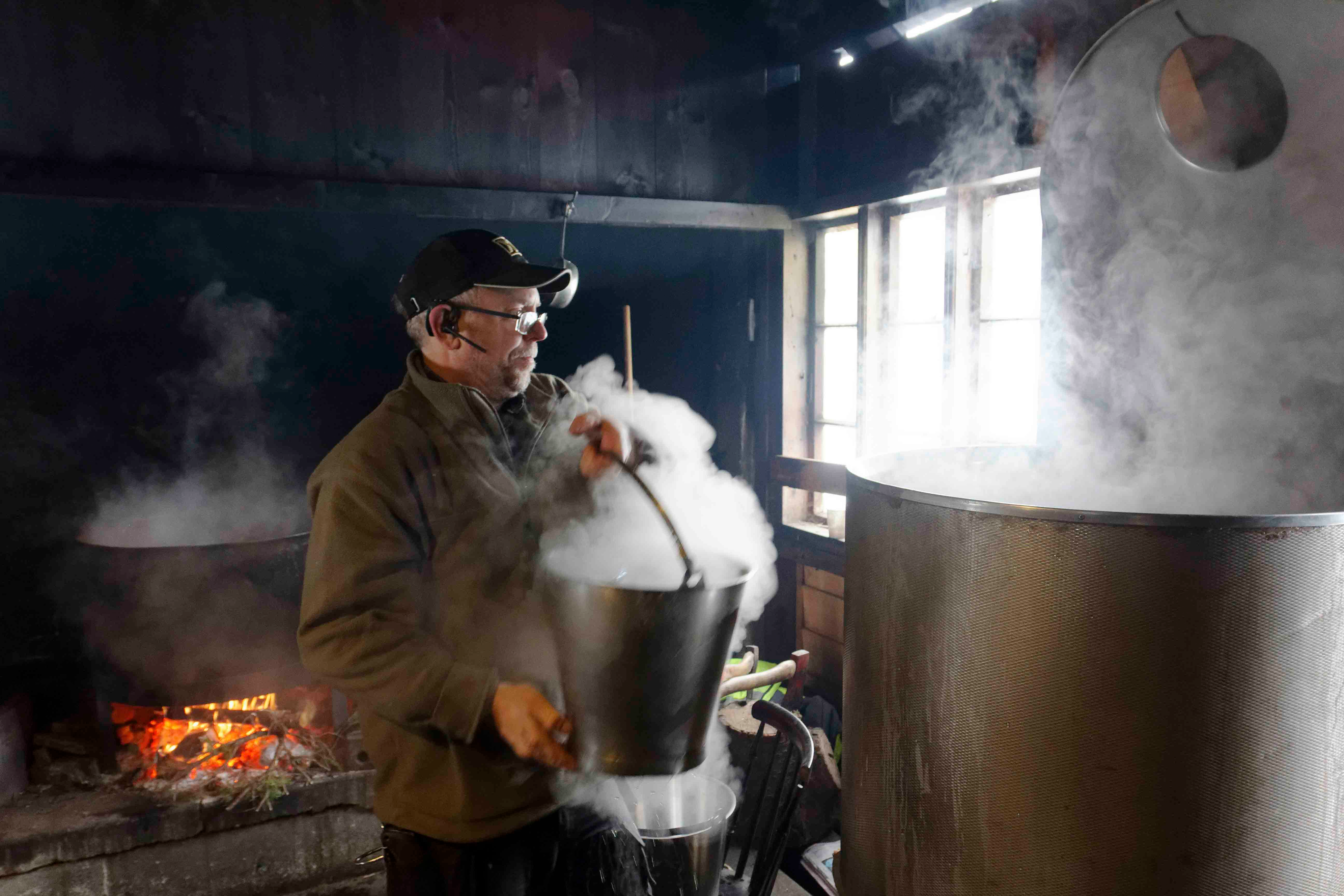
It was only when I went on a tour of Lithuanian breweries that I started to understand. Some of them were relatively normal commercial breweries, others were not. The farmhouse brewer Ramūnas Čižas explained to me how he learned to brew from his father, who again learned from his father. His grandfather’s brew kit was all made of wood, except the iron kettle. The yeast he had inherited together with the knowledge of brewing, and the hops grew along the wall of his brewhouse.
And that wasn’t even the biggest surprise. It turned out that when brewing he baked the mash in an oven. His brewing process was just completely unlike any modern beer I had ever heard of. The day after I was in a daze, trying to understand what this meant. Gradually I realized that these Lithuanian beers were so different from modern beers because they weren’t modern beers at all, but a separate tradition among the farmers that had somehow survived in the hinterland of north Lithuania.
During communism many of these farmers started selling their beer, because the commercial beer in this era was not good. When the Soviet Union collapsed, many of them seized the chance and turned their farms into literal farmhouse breweries. Ramūnas Čižas’s brewery, for example, is in what used to be the barn on the farm.
Coming back to my native Norway I had another realization: we had something like this in Norway, too! I knew that in the county of Stjørdal in central Norway the farmers made a very strange, intensely smoky beer according to some local tradition. Maybe there was more?
Teaming up with Canadian journalist Martin Thibault, I spent an enormous amount of time–over nine months–searching the internet to find Norwegian farmhouse brewers to visit. Eventually we set off on a weeklong expedition through western and central Norway. What we found simply stunned us. Farmhouse brewing was not only alive across large stretches of Norway, but the beer was part of a larger beer culture we’d never dreamed existed.
In Voss, western Norway, we met one brewer who, like Ramūnas Čižas, was using a yeast he had inherited. He told us that he pitched it into wort at 39C. We could barely believe it! It shouldn’t be able to ferment at all at that temperature. And yet the yeast yielded an aroma of spice and oranges unlike any other yeast we’d ever experienced.
A couple of days later a group of older gentlemen served us beer in wooden bowls painted with floral patterns. This used to be the traditional way to drink beer in Norway. Looking more closely at my bowl I found it had a verse around the rim:
Før sto jeg i grønne lunder,
nå slukker jeg tørste munder.
(I used to grow in green groves,
now I slake thirsty mouths.)
The bowl was speaking to me! That, too, I later learned was traditional. In fact, beer bowl rhymes are an entire literary genre in Norway.
They told us that some locals brew without boiling the wort, something brewers up until then thought was impossible because it would make the beer go distastefully sour. The next day, we met a farmer who served us this kind of raw ale and it was not sour at all. But the flavors were very different from beers whose wort had been boiled.
On and on it went for an entire week. At the end we were so awestruck we were hardly able to absorb any more information. I barely have any notes from my last brewery visits. I couldn’t handle any more discoveries.
That trip literally changed my life and made me insatiably curious to see what else I could discover. That turned out to be quite a lot. There were similar brewers in eastern Norway, too. And on the Estonian islands in the Baltic. And in eastern Latvia. In Belarus. In central Russia. Even in the UK! Most of these were still true farmhouse brewers, brewing at home for themselves, though a select few have gone commercial.
It also turned out that archives and museums in northern Europe have enormous troves of ethnographic documentation of farmhouse brewing. It is possible to reconstruct what farmhouse brewing was like in many parts of Europe where it is now extinct.
Although a lot of information about true farmhouse ales has now been published by myself and others, the beers themselves remain elusive for most drinkers. Several commercial breweries that stay true to farmhouse brewing traditions exist in Lithuania. There are also two in Estonia, a few in Finland, one on Gotland, one in Denmark, and one in Norway. Their beers are very rarely exported.
Some modern brewers have started commercial breweries trying to replicate these beers so modern drinkers can try them, but they are facing a market of drinkers who have no idea what these beers are. And when people do try them they discover the beers are strange and completely unlike what they expected or are used to.
So far only one part of this enormous heritage has taken off internationally: the Norwegian yeast known as “kveik”. That brewer in Voss, Sigmund Gjernes, shared his yeast with us and we passed it on to homebrewers, yeast labs, and commercial breweries. Later, many other kveik yeast cultures were also spread.
Home brewers in particular love that kveik can ferment at almost any temperature up to 40C with no off flavors. It furthermore ferments very fast, producing perfectly drinkable beer within two to three days. Finally, the yeast is quite robust, making it harder to ruin the beer by mistreating the strain.
These yeasts tend to be much more aromatic than ordinary yeast, adding tropical fruit flavors like orange, pineapple, banana, and so on. People tend to be divided about this. Some like it and some don’t, but yeast labs have started finding strains which are much more neutral. Some of these have become popular, too.
Having survived, as if by a miracle, from times now forgotten into the present, the future of these beers remains uncertain. As long as people want to drink them they will survive, but how long that will be is hard to guess. Many beer drinkers have these beers on their bucket list. There, they are sadly likely to remain because of how hard the beers are to get hold of. Maybe you just need thirst and determination.